candidate screening
September 18, 2026
Beyond the Keyword: How AI Candidate Screening Evaluates True Role Fit in 2026
AI candidate screening is moving beyond keyword matching to evaluate true role fit, helping recruiters qualify candidates faster and more consistently. See how it works and how Scout brings this to Cooper's hiring workflow.
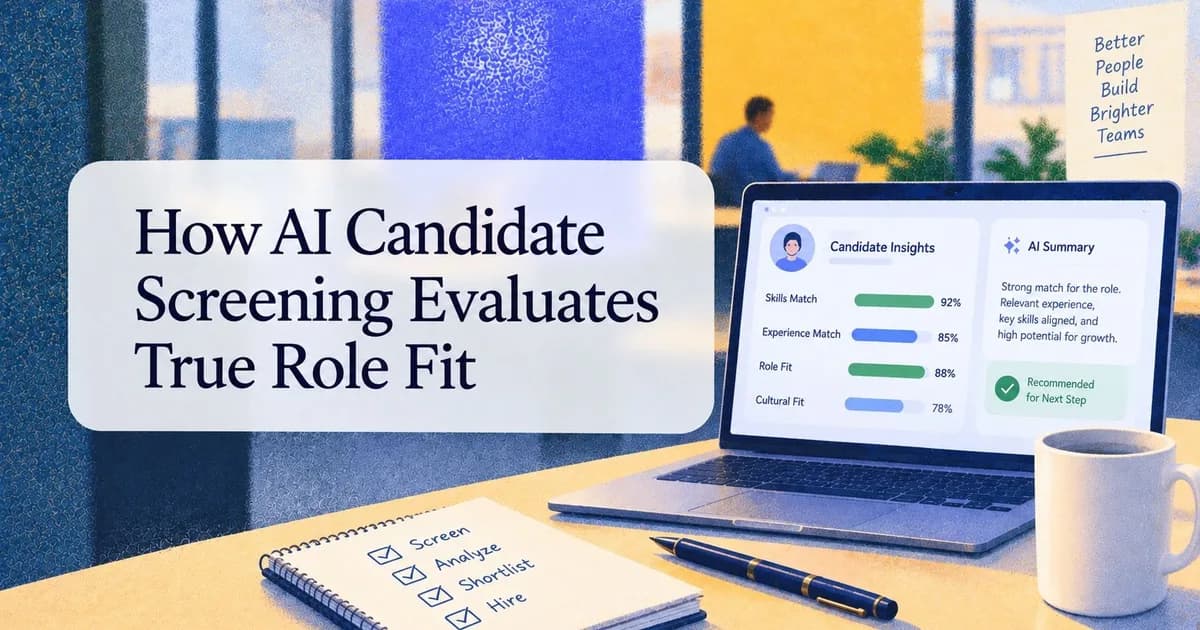
A recruiter opens a new software engineering role. Within 48 hours, more than 300 applications arrived.
On paper, that sounds like success. In reality, it creates a different problem.
Some resumes are clearly unqualified. Others appear impressive at first glance but reveal little about whether the candidate can actually succeed in the role. A handful mention every keyword from the job description. Some highly capable candidates use entirely different terminology and risk being overlooked.
The recruiter starts reviewing resumes.
Thirty seconds per profile. Then twenty. Then fifteen.
As application volume grows, decision quality inevitably declines, not because recruiters become less capable, but because the human brain isn't designed to make hundreds of complex hiring decisions in a single day.
For years, recruiting technology tried to solve this problem with keyword matching. If the resume contained the right skills, certifications, or job titles, the candidate moved forward.
If it didn't, the candidate disappeared into the rejection pile. It seemed efficient.
But it wasn't necessarily effective. Hiring isn't about matching words. It's about matching people to opportunities.
That's why AI candidate screening has become one of the most significant shifts in modern recruiting. The newest generation of AI screening software isn't asking whether a candidate repeated the right keywords.
It's asking a much better question: "Does this person genuinely fit the role?"
That subtle difference is changing how organizations evaluate talent, and why recruiters are beginning to trust AI as a decision-support tool rather than simply another automation platform.
Why Keyword-Based Screening Was Never Enough
Keyword screening made perfect sense twenty years ago.
Recruiters received fewer applications. Job descriptions were relatively standardized. Career paths were predictable.
If someone had "Java Developer" on their resume, chances were they had spent years writing Java.
Today's labor market looks very different. Candidates build careers across multiple industries.
Job titles vary dramatically between companies. Skills evolve faster than resumes.
And many of the best candidates don't describe themselves using the exact language recruiters expect.
Consider two candidates applying for the same role.
One lists:
• Customer Success Manager
• CRM
• SaaS
• Enterprise Accounts
• Account Expansion
Another writes:
• Client Growth Lead
• Customer Lifecycle
• Revenue Retention
• Strategic Partnerships
• Commercial Success
Traditional keyword screening might rank the first candidate higher simply because the terminology aligns more closely with the job description.
A human recruiter, however, would probably recognize that both candidates possess highly transferable experience.
That's the gap AI candidate screening is beginning to close. Instead of matching language, modern systems increasingly evaluate meaning.
The Difference Between Matching Keywords and Understanding Context
This is where recruiting technology is undergoing its biggest transformation.
Traditional applicant tracking systems answered a relatively simple question: "Does this resume contain the words I'm looking for?"
Modern AI candidate screening asks something far more valuable: "Does this candidate demonstrate the capabilities required to succeed?"
Those questions produce very different outcomes. Imagine you're hiring a Product Marketing Manager.
Candidate A has held exactly that title. Candidate B spent five years leading product launches as a Growth Marketing Lead before transitioning into product strategy.
A keyword filter might strongly favor Candidate A. An experienced recruiter might realize Candidate B has equally relevant, or even stronger experience.
Modern AI screening software attempts to recognize those contextual relationships automatically. Instead of relying exclusively on titles, it considers how experience connects to hiring requirements.
That dramatically expands the pool of qualified candidates while reducing the likelihood of overlooking unconventional talent.
What AI Candidate Screening Actually Evaluates
One of the biggest misconceptions about AI candidate screening is that it simply reads resumes faster than humans.
That's only a small part of the story.
Modern AI screening software evaluates a much broader set of hiring signals. Rather than looking at resumes as isolated documents, it attempts to build a richer picture of candidate suitability.
Depending on the platform, AI candidate screening may evaluate:
• Relevant skills and competencies
• Depth of experience
• Career progression
• Industry relevance
• Project complexity
• Role alignment
• Qualification requirements
• Education and certifications
• Location preferences
• Work authorization
• Publicly available professional information
• Application responses
• Hiring intent indicators
None of these signals, on their own, determine whether someone should be hired. Together, they create a more complete understanding of role fit.
That's a meaningful shift from filtering candidates to evaluating them.
AI Candidate Screening Is Really About Candidate Qualification
One of the reasons recruiters remain skeptical about automation is that screening has historically been treated as a filtering exercise.
Applications entered the system. Candidates were accepted or rejected.
There was very little nuance.
Modern AI candidate screening is moving toward candidate qualification instead.
Qualification asks a fundamentally different question.
Not: "Should this candidate be rejected?"
But: "How well does this candidate align with the hiring requirements?"
That's an important distinction. Strong AI screening software doesn't simply eliminate candidates. It prioritizes them.
For example, candidates may be grouped into categories such as:
• Excellent Match
• Strong Match
• Worth Reviewing
• Missing Key Requirements
Recruiters still make the decision. The platform simply helps determine where recruiter attention should go first. That creates a much healthier relationship between AI and human judgment.
How Modern AI Candidate Screening Works
Although platforms vary, most modern AI screening workflows follow a similar process.
Step 1: Define Success Before Screening Begins
Everything starts with clarity. Rather than relying solely on a job description, recruiters define what success actually looks like in the role.
That often includes:
• Essential skills
• Preferred experience
• Must-have qualifications
• Team context
• Seniority expectations
• Technical competencies
• Behavioral requirements
• Hiring priorities
This hiring brief becomes the foundation for candidate evaluation. The better the hiring criteria, the stronger the recommendations become.
Step 2: Analyze Multiple Candidate Signals
Once candidates enter the hiring pipeline, AI screening software begins evaluating available information. Instead of searching for isolated keywords, modern systems look for patterns across multiple signals.
• Experience
• Skills
• Career trajectory
• Relevant achievements
• Qualifications
• Professional context
Each piece contributes to an overall understanding of candidate suitability.
Step 3: Prioritize Candidates Instead of Rejecting Them
One of the biggest improvements AI introduces is changing recruiter workflow. Recruiters no longer begin by reading every application.
Instead, they review candidates ranked according to hiring priorities. This doesn't eliminate recruiter judgment.
It simply allows recruiters to spend their time where it creates the greatest value.
Step 4: Provide Context Behind Recommendations
Good AI candidate screening should never behave like a black box. Recruiters need to understand why candidates were recommended.
Modern AI screening software increasingly explains its reasoning by highlighting:
• Matching skills
• Relevant experience
• Qualification strengths
• Potential gaps
• Overall role alignment
That transparency builds recruiter confidence and encourages better hiring decisions.
Traditional Resume Screening vs AI Candidate Screening
The easiest way to understand the shift is to compare the two approaches.
Category | Traditional Resume Screening | AI Candidate Screening |
Evaluation Method | Keyword matching and manual review | Contextual candidate qualification |
Primary Focus | Resume content | Overall role fit |
Decision Process | Filter candidates in or out | Prioritize candidates based on fit |
Recruiter Workload | High manual review effort | AI-assisted prioritization |
Candidate Evaluation | Resume-by-resume | Multi-signal assessment |
Consistency | Varies by recruiter | Standardized qualification framework |
Scalability | Limited by recruiter capacity | Supports high-volume hiring |
Recruiter Role | Resume reviewer | Hiring decision-maker |
Notice what changed. The goal isn't simply processing resumes faster.
The goal is helping recruiters spend less time searching for qualified candidates and more time evaluating the candidates most likely to succeed.
That's a very different philosophy, and it's quickly becoming the standard for modern hiring.
The Real Benefits of AI Candidate Screening
When people hear the phrase AI candidate screening, they often assume the biggest advantage is speed.
Speed certainly matters. But it's not the reason the best recruiting teams are investing in AI. The real value lies in helping recruiters make better decisions with the same amount of time.
AI doesn't magically create more hours in the day. It helps recruiters spend those hours on work that actually improves hiring outcomes.
Better Recruiter Productivity
Ask almost any recruiter where their time goes. The answer usually isn't interviews.
It's everything surrounding interviews.
• Reviewing applications
• Comparing resumes
• Moving candidates between stages
• Writing notes
• Following up with hiring managers
Administrative work slowly consumes the week.
AI candidate screening reduces that operational burden by organizing, qualifying, and prioritizing candidates before recruiters begin reviewing applications.
Instead of spending three hours deciding which candidates deserve attention, recruiters can begin the day with a qualified shortlist already waiting.
That changes the nature of the job. Recruiters become talent advisors instead of resume reviewers.
More Consistent Hiring Decisions
One recruiter might prioritize industry experience. Another may focus on technical skills. A third may value career progression.
None of those approaches are inherently wrong. But inconsistency creates hiring risk.
Modern AI screening software introduces structured qualification criteria that every candidate is evaluated against.
This doesn't remove recruiter judgment. It creates a common starting point.
Candidates receive a more consistent evaluation, and hiring managers receive stronger, more comparable shortlists.
Better Candidate Experience
Candidate experience is often discussed in terms of employer branding. In reality, it begins with responsiveness.
Candidates don't expect immediate job offers. They do expect progress.
When recruiters spend days manually reviewing resumes, candidates wait.
Some accept offers elsewhere. Others lose interest.
AI candidate screening shortens the time between application and recruiter response by helping teams identify qualified candidates sooner.
The experience feels faster because the process actually is faster.
Improved Hiring Quality
Perhaps the biggest benefit of AI candidate screening is one that's surprisingly difficult to measure.
Better decisions.
Keyword filters frequently overlook candidates with transferable experience. Human reviewers occasionally miss relevant profiles because of fatigue or inconsistent evaluation.
AI doesn't eliminate those risks entirely. But by evaluating multiple qualification signals instead of relying only on keywords, it increases the likelihood that strong candidates receive recruiter attention.
Over time, that improves hiring quality.
Common Misconceptions About AI Candidate Screening
Like any emerging technology, AI candidate screening has generated its share of misconceptions.
The reality is far less dramatic than many headlines suggest.
"AI automatically rejects candidates."
Not necessarily. The strongest AI recruiting platforms don't function as automatic rejection engines.
Instead, they rank candidates based on role fit and provide recruiters with recommendations. Humans remain responsible for hiring decisions.
"AI replaces recruiters."
This is probably the most persistent myth.
Recruiters aren't being replaced. Their responsibilities are changing.
Administrative work decreases. Strategic work increases. That's a meaningful distinction.
"AI is only looking for keywords."
That may have been true for older screening systems. Modern AI candidate screening increasingly evaluates context rather than simple keyword overlap.
The objective isn't identifying candidates who wrote the perfect resume. It's identifying candidates who are most likely to succeed in the role.
"AI makes hiring less fair."
AI can improve consistency, but fairness isn't automatic. Poorly designed hiring criteria can create poor recommendations, whether decisions are made by humans or software.
The most effective organizations treat AI as decision support, not decision replacement. They regularly review qualification criteria, audit hiring outcomes, and ensure recruiters can override recommendations when appropriate.
Responsible AI always keeps humans accountable for final hiring decisions.
What Should You Look for in AI Candidate Screening Software?
When comparing AI candidate screening software, here are the capabilities that matter most.
Context-Based Qualification: The platform should evaluate role fit, not just keyword overlap. Look for software that understands experience, transferable skills, career progression, and hiring requirements.
Transparent Recommendations: Recruiters should always understand why a candidate was recommended. Strong AI recruiting software explains its reasoning instead of producing unexplained scores. Transparency builds confidence and improves adoption.
Custom Qualification Criteria: Every organization hires differently. The best AI screening platforms allow recruiters to define must-have qualifications, preferred experience, knockout criteria, nice-to-have skills, and role-specific competencies. AI should adapt to your hiring process, not force you into someone else's.
Workflow Integration: Candidate screening shouldn't operate in isolation. It should connect seamlessly with sourcing, applicant tracking, interviews, and recruiter collaboration. Disconnected tools create disconnected hiring experiences.
Human Oversight: The strongest AI hiring software always keeps recruiters in control. Recommendations should guide decisions, not replace them. Human judgment remains essential.
Why Scout Is Built for Modern Candidate Screening
Most recruiting software helps teams organize applications. Scout AI Agent helps teams understand them.
As Cooper's AI Screening Agent, Scout is designed to move beyond keyword matching and support a more intelligent qualification process.
Instead of simply filtering resumes, Scout evaluates candidates against the hiring criteria that matter most to your organization. Recruiters can define must-have qualifications, preferred experience, and role-specific requirements, while Scout helps prioritize candidates based on overall fit rather than isolated keywords.
Every recommendation is supported with qualification context, allowing recruiters to understand why a candidate appears to be a strong match instead of relying on an unexplained score.
The outcome is simple. Recruiters spend less time reviewing applications. Hiring managers receive stronger shortlists.
Candidates move through the hiring process faster. And teams make more consistent hiring decisions.
Why Candidate Screening Works Better Inside Cooper
Screening doesn't happen in isolation. It's one step in a much larger hiring journey.
That's why Cooper connects candidate sourcing, AI screening, interviews, and applicant tracking into one connected hiring workflow.
Instead of moving candidates manually between disconnected systems, Cooper allows recruiting teams to:
• Discover candidates through Coo
• Qualify applicants using Scout
• Conduct structured first-round interviews with Robin
• Collaborate with hiring managers
• Manage the entire hiring pipeline in one place
The result isn't simply faster recruiting. It's a hiring process where every stage builds naturally on the one before it.
No duplicate work. No manual imports. No disconnected hiring tools.
Just one connected AI hiring platform designed to help recruiting teams hire better.
Final Thoughts
For years, recruiting technology tried to solve hiring with better filters.
The assumption was simple. If we could match the right keywords, we'd find the right candidates.
Experience has shown otherwise.
Great candidates don't always describe themselves using identical language. Career paths are rarely linear. Skills transfer across industries. Potential isn't captured in a keyword list.
That's why AI candidate screening represents such an important shift. It moves recruiting away from matching words and toward understanding people.
The goal isn't to replace recruiter expertise. It's to amplify it.
When AI handles repetitive qualification work, recruiters gain something far more valuable than speed.
• They gain time
• Time to build relationships
• Time to partner with hiring managers
• Time to evaluate candidates thoughtfully
• And ultimately, time to make better hiring decisions
The future of recruiting won't belong to organizations that review resumes faster. It will belong to organizations that understand candidates better.
FAQs
What is AI candidate screening?
AI candidate screening is the process of using artificial intelligence to evaluate, prioritize, and qualify candidates based on predefined hiring criteria. Instead of relying solely on keyword matching, modern AI screening software analyzes multiple signals, including skills, experience, career progression, qualifications, and role alignment, to help recruiters identify the strongest candidates more efficiently.
How is AI candidate screening different from traditional resume screening?
Traditional resume screening primarily relies on manual review or keyword filters. AI candidate screening goes beyond keywords by evaluating the overall context of a candidate's background, transferable skills, qualifications, and role fit. The goal is to prioritize candidates based on their likelihood of success rather than whether their resume contains exact matching terms.
What are the benefits of AI candidate screening?
AI candidate screening helps organizations reduce manual resume review, improve recruiter productivity, create more consistent candidate evaluations, shorten time-to-shortlist, enhance candidate experience through faster responses, and improve hiring quality by prioritizing candidates based on overall role fit instead of simple keyword matching.
Can AI candidate screening replace recruiters?
No. AI candidate screening is designed to support recruiters, not replace them. AI automates repetitive qualification tasks and surfaces stronger candidate recommendations, while recruiters continue to evaluate candidates, conduct interviews, collaborate with hiring managers, and make final hiring decisions.
What should companies look for in AI candidate screening software?
The best AI candidate screening software should offer contextual candidate qualification, transparent recommendation logic, customizable hiring criteria, recruiter review controls, ATS integration, workflow automation, and analytics. Organizations should prioritize platforms that improve hiring decisions while keeping recruiters in control.
Which companies benefit most from AI candidate screening?
AI candidate screening is particularly valuable for startups, scaleups, enterprise recruiting teams, staffing firms, and organizations managing high-volume hiring. It helps these teams evaluate large numbers of applicants consistently, reduce recruiter workload, improve candidate quality, and accelerate hiring without increasing recruiting headcount.
Read more
Candidate Sourcing
AI Candidate Sourcing vs LinkedIn Recruiter: Which Delivers Better Results?
AI candidate sourcing and LinkedIn Recruiter solve different problems. Compare how each performs on candidate discovery, passive sourcing, cost, and high-volume hiring to find the right fit for your team.
AI Recruiting
15 Recruitment Metrics Every Hiring Team Should Track in 2026
A complete framework of 15 recruitment metrics covering speed, efficiency, cost, quality, candidate experience, and pipeline health, and how AI recruiting is changing what good measurement looks like in 2026.
Candidate Interview
How AI Interview Agents Reduce Time-to-Hire Without Sacrificing Candidate Experience
AI interview agents remove the scheduling and coordination friction that slows hiring down, helping teams cut time-to-hire while giving candidates a faster, more responsive experience.