Applicant Tracking System
October 30, 2026
Greenhouse vs Workable: Which Recruiting Platform Is Right for Your Team?
Greenhouse or Workable? Compare sourcing, screening, interviewing, AI, reporting, ease of use and pricing, and see which ATS fits your team size and hiring volume.
Greenhouse and Workable tend to land on the same shortlist when a company outgrows spreadsheets or a basic job board, and the reason is simple enough: both are mature applicant tracking systems with years of customer feedback behind them. Where they part ways is in who they were built for. Greenhouse grew up around structured hiring for companies with formal interview processes, multiple hiring teams and a recruiting operations function, while Workable set out to give smaller and mid-sized teams a recruiting system they could switch on quickly, and it has since added a full HR suite and a set of AI agents.
In this comparison we look at sourcing, screening, interviewing, AI, reporting, ease of use and pricing, using each vendor's own pricing pages, product pages and help documentation.
Before you read on, it helps to know your rough hiring volume, how much of your process you want automated, and whether you need HR tools in the same system.
Greenhouse vs Workable: At a Glance
Greenhouse is a recruiting platform built around structured hiring. Interview kits, scorecards, approvals and reporting are at the center of the product, and recent releases have added native scheduling, an AI notetaker, fraud detection under the Real Talent name, and a voice AI interviewer that came through the acquisition of Ezra AI Labs. Pricing is quote based across three plans called Core, Plus and Pro.
Workable combines an applicant tracking system with sourcing, job distribution to more than 200 job boards, HR software and a set of Workable Agents that write job briefs, source passive candidates, screen applicants and follow up with them in chat. Its plans start at $299 a month, and the agents run on an AI credit model.
Which one fits better depends on your hiring volume, how complex your workflows and approvals are, how much sourcing you do, how far you want automation to go, which systems you need to connect, and what you can spend.
Greenhouse | Workable | |
|---|---|---|
Best for | Mid-market and enterprise teams running formal, structured hiring with several hiring teams | Small and mid-sized companies that want recruiting and HR in one system with transparent pricing |
ATS | ✓ | ✓ |
Candidate sourcing | CRM, Chrome extension and Sourcing Automation (email sequences and contact lookup, Plus plan and above) | Search across 400M+ profiles, 200+ job boards, talent pools, Sourcing Agent |
Candidate screening | Talent Matching against recruiter-weighted criteria, keyword suggestions, fraud and spam detection | AI scoring against the job, Yes/No knock-out questions, Screening Agent with a 14-dimension candidate profile |
AI capabilities | 17 documented AI features, plus Voice AI interviews and Real Talent | AI sourcing and screening, recruiter assistant, Workable Agents on AI credits |
Interview management | Interview kits, scorecards, native scheduling, AI Notetaker | Interview kits and scorecards, self-scheduling, live and one-way video (premium) |
Reporting | Greenhouse Analytics, AI report filters and BI Connector on Plus | Custom report builder, scheduled reports, EEO and OFCCP reporting, BI integrations |
Integrations | 250+ integration partners, Harvest API, MCP (beta) | Open API, partner program, BI tools, MCP server included on all plans |
Pricing | Custom quote for Core, Plus and Pro | Standard $299/mo, Premier $599/mo, Enterprise $719/mo, plus AI credits |
High-volume hiring | Talent Matching, fraud detection, Voice AI first-round interviews | Knock-out questions, bulk AI screening, Screening and Engagement Agents |
Ease of use (G2) | 8.5 / 10 | 9.0 / 10 |
Pricing checked: Oct 2026. Sources: vendor pricing and product pages linked throughout, G2 comparison page for ease of use scores.
What is Greenhouse?
Greenhouse is a hiring platform whose central idea is that every candidate for a role should be assessed against the same criteria, by interviewers who know what they are meant to be testing. That philosophy shows up across the product. Each job gets a set of attributes, interviewers get interview kits with questions tied to those attributes, and feedback comes back as a scorecard rather than a free-form opinion and it serves more than 7,500 companies.
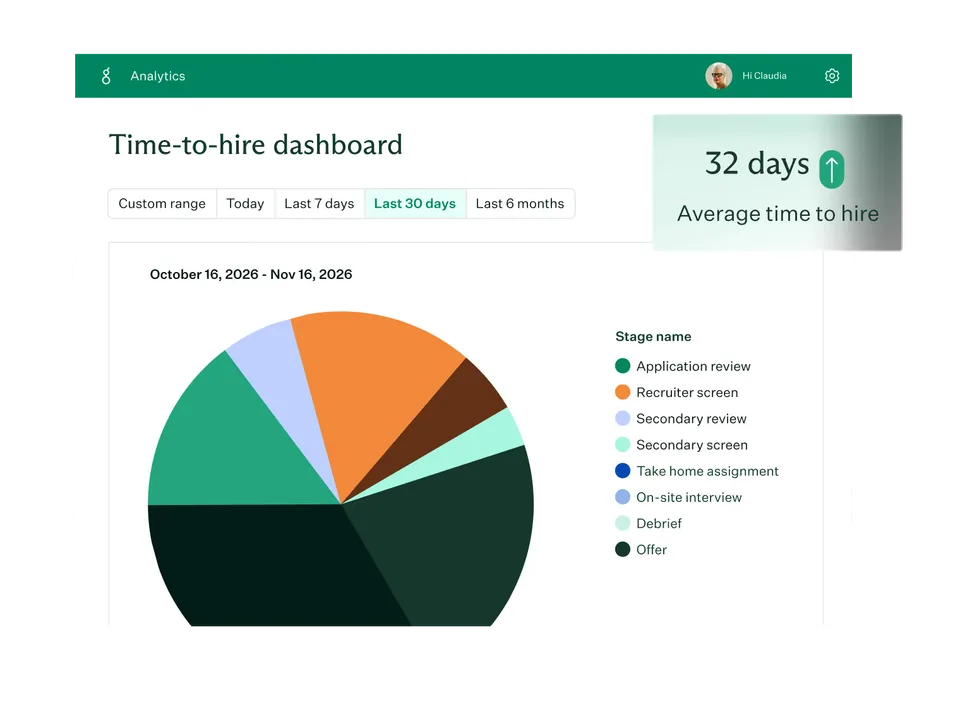
On the applicant tracking side, Greenhouse covers job setup, approvals, application review, stage management, offers and onboarding. Sourcing sits in a built-in CRM that every plan includes, with a Chrome extension for adding prospects from the web, and a separate Sourcing Automation product for email outreach that the pricing page places in the Plus plan. Interviewing became more self-contained, when Greenhouse launched native scheduling alongside a rebuilt analytics product.
AI is spread across the product rather than packaged as one assistant, ranging from scorecard summaries and interview question suggestions to talent matching and an offer acceptance forecast. The typical Greenhouse customer is a mid-market or enterprise company with a dedicated talent team, which is consistent with how G2 reviewers describe themselves.
Greenhouse Key Features
- Applicant tracking: job approvals, configurable hiring stages, offers, and candidate communication in one record.
- Structured hiring: job attributes, interview kits and scorecards that keep every interviewer assessing the same things.
- Interview management: native scheduling with scheduling links, interviewer groups and availability-based suggestions, plus the AI Notetaker on all plans.
- Candidate sourcing: CRM and Chrome extension on every plan, with Sourcing Automation for outreach sequences on Plus and Pro.
- Reporting and analytics: Greenhouse Analytics, with AI report filters and a Business Intelligence Connector on Plus and above.
- Integrations: more than 250 integration partners, the Harvest API, and MCP access in open beta.
- AI capabilities: Talent Matching, fraud and spam detection, scorecard summaries, question suggestions, Voice AI and more.
What Is Workable?
Workable started as an applicant tracking system for growing companies and has gradually become a broader recruiting and HR suite. Every paid plan now includes both a recruiting module and an HR module, covering things like employee records, onboarding, time off, time tracking and payroll preparation. For a company that does not yet have an HRIS, that bundling is a large part of the appeal.
The recruiting side covers job posting to more than 200 free and premium job boards, a careers page builder, a talent CRM, AI-assisted search across what Workable describes as 400M+ profiles, configurable pipelines, interview kits and scorecards, and a mobile app that lets hiring managers review candidates and approve requests away from their desk. Screening tools range from simple Yes/No knock-out questions on the application form to AI scoring of every applicant against the job description.
There are four agents: a Job Brief Agent, a Sourcing Agent, a Screening Agent and an Engagement Agent, and they are sold as a paid add-on that runs on AI credits. Video interviews, texting and assessments are included in Premier and Enterprise and available as add-ons on Standard. Workable's customer base leans toward small and mid-sized businesses.
Workable Key Features
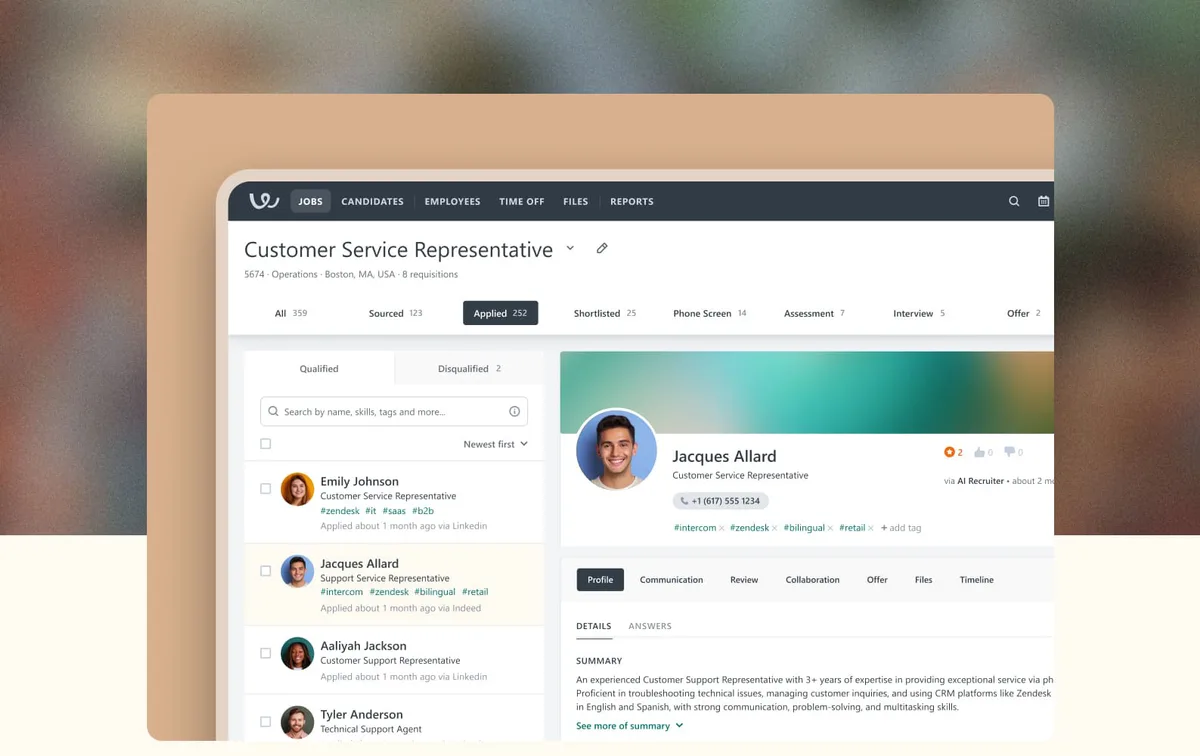
- Applicant tracking: configurable pipelines, candidate profiles, one-click sharing with hiring managers, and a mobile app.
- Candidate sourcing: AI search across 400M+ profiles, posting to 200+ job boards, a careers page builder and talent pools.
- Screening: AI match scoring, Yes/No knock-out questions, and assessments on Premier or as a Standard add-on.
- Interview management: interview kits, scorecards, self-scheduling through Google or Outlook calendars, and video interviews.
- Recruiting automation: automated actions per pipeline stage, plus the Workable Agents for sourcing, screening and follow-up.
- Reporting: a custom report builder across candidate, job, application, offer and employee data, with scheduled delivery.
- Integrations: an open API and developer partner program, BI tool connections, and an MCP server included on every plan.
- AI capabilities: job description writer, recruiter assistant, candidate rediscovery, AI outreach emails and the four Workable Agents.
Greenhouse vs Workable: Feature-by-Feature
Greenhouse vs Workable: Candidate Sourcing
Greenhouse treats sourcing as relationship management. Every plan includes a CRM where recruiters keep prospects, along with the Greenhouse Recruiting Chrome extension, which lets them add a prospect from a website, a resume or by hand without leaving what they are doing. Outreach at scale needs Greenhouse Sourcing Automation, which the pricing page lists in the Plus plan. That product handles multi-step email sequences with custom send schedules, an email coach that flags spam triggers while you write, and a contact lookup that finds personal email addresses 70 to 84% of the time and work email addresses 80 to 85% of the time. Greenhouse does not advertise its own searchable database of candidate profiles, so recruiters generally find people on LinkedIn, GitHub or similar sites and bring them into Greenhouse.
Workable puts more weight on finding candidates for you. Its sourcing page describes a search across 400M+ profiles that scores candidates against the job, and searches with AI that auto-sources matching profiles and shows highlights explaining each match, so a recruiter can preview them and add only the ones they want. On top of that, one posting can reach more than 200 job boards. Workable also resurfaces past applicants when a new role opens, ranking them by recency and relevance. With the add-on, the Sourcing Agent keeps looking for passive candidates on an ongoing basis and spends two AI credits for each one it adds.
Which is better for candidate sourcing?
Greenhouse is likely to suit teams that already know where their candidates are and want a disciplined way to track prospects, run nurture campaigns and measure outreach alongside the rest of a structured process. Workable may appeal more to teams that want the platform itself to produce candidates, either through its profile search and job board reach or through an agent that keeps sourcing in the background, without paying for a separate sourcing tool.
Greenhouse vs Workable: Candidate Screening
In Greenhouse, the main screening tool is Talent Matching, part of what the company calls Real Talent. Recruiters set up a weighted calibration describing what matters for the role, and Talent Matching scores resumes against it. Talent Matching assistant can turn a plain-language description of the ideal candidate into that calibration and its filters (Beta). Keyword suggestions, available on all tiers, help narrow application review, and resume anonymization on the Pro plan hides identifying details while people review.
Fraud has become a big part of how Greenhouse talks about screening. Real Talent flags spam and suspicious applications, and in its own internal pilot on a machine learning role Greenhouse reported that more than 35% of applicants carried high-risk signals and that 91% of the high-risk candidates its security team reviewed turned out to be fraudulent. Greenhouse is explicit that the system surfaces signals and that a person always decides who advances.
Workable takes a more rules-driven route at the front of the funnel. Application forms can include Yes/No knock-out questions, and a single No moves the candidate to a Disqualified tab automatically, where a recruiter can revert the decision if needed. AI screening then scores applicants against the job description using semantic matching and shows which skills and experience drove the score. The scores are a starting point for human review and that protected characteristics are not used. The Screening Agent goes further, evaluating every applicant against an Ideal Candidate Profile across 14 dimensions, and the Engagement Agent opens a chat with candidates when information is missing and then re-scores them.
What to consider
Teams hiring for skilled roles who worry about fake or AI-generated applications, and who want recruiters to stay firmly in control of every decision, will probably find Greenhouse's combination of Talent Matching and fraud signals a good fit. Teams that receive a lot of applications with clear minimum requirements, such as a licence, a location or a shift pattern, may get more immediate value from Workable's knock-out questions and from agents that chase missing details without a recruiter having to step in.
Greenhouse vs Workable: Interviewing
Interviewing is where Greenhouse's structured hiring roots show most clearly. Interview kits give each interviewer the questions to ask and the attributes they are assessing, and scorecards capture feedback against those attributes so hiring teams compare candidates on the same terms.
AI helps at several points: Greenhouse can suggest scorecard attributes and interview questions from the job description, summarize a stack of scorecards into points of agreement and disagreement, and clean up the wording of written feedback. Greenhouse Scheduling, added scheduling links, interviewer groups and suggested interviewers based on availability. The Greenhouse Notetaker joins Zoom, Google Meet or Teams calls, transcribes them and drafts notes mapped to scorecard questions, which the interviewer reviews before submitting. It is off by default.
Greenhouse also has a first-round option that does not need a recruiter at all. Greenhouse Voice AI, based on the Ezra technology, runs a two-way voice interview using questions and scoring criteria the team defines, which candidates can take on their own schedule. Recruiters get an evaluation with a rationale, every score can be overridden, and the product is audited monthly for bias by Warden AI (Greenhouse Voice AI).
Workable also supports interview kits and scorecards, and its pipelines let teams attach evaluation steps to particular stages. Scheduling works through the Google, Microsoft and Zoom integrations, and connecting Google or Outlook calendars adds self-scheduled and multi-part interviews. One-way video interviews, where candidates record answers on their own time, are a premium feature under Workable Video Interviews. Interview transcription is available through integrations with Supernormal or BrightHire rather than as a native notetaker.
Workable's AI interview question generator produces competency-based questions with suggested scoring criteria for each one.
Greenhouse vs Workable: AI Recruiting
Both vendors have moved quickly on AI, but they have done it in noticeably different ways, so it helps to list what each one actually does.
What Greenhouse's AI does
- AI matching: Talent Matching scores resumes against a weighted calibration that the recruiter sets, and the Talent Matching assistant drafts that calibration from a plain-language brief.
- AI screening and fraud detection: Real Talent flags spam and fraud signals during application review, with identity verification through CLEAR announced for MyGreenhouse.
- AI interviewing: Voice AI conducts structured first-round voice interviews and supports ten languages beyond its base set, including Spanish, German, Hindi and Japanese, and Voice AI customers can now advance or reject candidates from inside it, with the status syncing back to Greenhouse.
- AI-generated insights: scorecard summaries, job notes summaries, the Candidate Insights Assistant (open beta) for plain-language questions about one candidate, and an offer forecast that predicts when an offer may be accepted.
- AI sourcing support: campaign drafting and resume-based personalization for Sourcing Automation emails, plus prospect response review, which automatically marks favorable replies as interested.
- Content help: job post drafts, interview question and scorecard attribute suggestions, and an email generator.
What Workable's AI does
- AI sourcing: Search with AI auto-sources matching profiles, and the Sourcing Agent reaches passive candidates continuously.
- AI screening: semantic scoring of every applicant, and a Screening Agent that evaluates candidates against an Ideal Candidate Profile across 14 dimensions.
- AI candidate engagement: the Engagement Agent opens a personalized conversation to collect missing information and then re-scores the candidate.
- AI job briefs: the Job Brief Agent turns a conversation about the role into requirements, dealbreakers, priorities, a job description and interview questions.
- Candidate recommendations: rediscovery surfaces past applicants who match a new opening, ranked by recency and relevance.
- AI assistant: summarizes candidates on request, drafts outreach and rejection emails, answers pipeline questions and writes follow-up notes from interviewer feedback.
- Connected AI: the Workable MCP server, included on all plans, lets assistants such as Claude or ChatGPT pull candidate lists or move applicants through the pipeline.
Put side by side, Greenhouse's AI is wider in scope, reaching into interviews, feedback and forecasting, while Workable's is more autonomous at the top of the funnel, where agents can source, screen and message candidates with less recruiter effort per applicant. Greenhouse's strongest automated step is the Voice AI interview, and Workable's is the chain of sourcing, screening and engagement agents.
Greenhouse vs Workable: Reporting & Analytics
Greenhouse rebuilt its reporting as Greenhouse Analytics, which brings recruiting data into one place with interactive reports that can be filtered and pivoted without technical skills, covering pipeline health, time to hire and conversion rates. On Plus and Pro, AI report filters let users describe the report they want in plain language, and a Business Intelligence Connector feeds data to an existing data warehouse or BI tool. Because interview feedback is captured in structured scorecards, the data behind each hiring decision is recorded in a consistent format, which helps when a company wants to look back at how and why candidates were chosen.
Workable's custom report builder lets users filter on any field across candidates, jobs, applications, offers and employees, including custom fields, and then save and schedule the reports. Standard recruiting metrics such as time to hire, time to fill, pipeline conversion, offer acceptance and source effectiveness are covered, along with EEOC and OFCCP reporting for US employers. Because Workable also holds HR data, the same reporting can show headcount changes, time off and performance reviews, which gives a basic workforce view that Greenhouse, as a recruiting system, does not try to provide. Teams with heavier analysis needs can connect Tableau, Looker or Power BI.
Greenhouse vs Workable: Ease of Use
On G2's head-to-head comparison, both products hold an overall rating of 4.4 out of 5, but Workable scores higher on every ease measure: 9.0 against 8.5 for ease of use, 8.6 against 8.1 for ease of setup, and 8.7 against 8.4 for ease of admin (G2).
Those numbers line up with how the products are put together. Workable offers a 15-day free trial with the full Standard plan and no credit card, which means a small team can set up jobs and start receiving applicants before speaking to sales. Greenhouse has no free trial, and implementation usually involves designing interview plans, scorecards, approvals and permissions, which takes longer but produces a more controlled process.
For hiring managers, Greenhouse's interview kits make it clear what to ask and how to score, while Workable's mobile app makes it easy to review and approve on the go. Reviewers on G2 mention limited customization and missing features as the most common complaints for both products, and some Workable reviewers raise the cost of AI add-ons.
Greenhouse vs Workable: Pricing
How Much Does Greenhouse Cost?
Greenhouse does not publish prices. Its pricing page lists three plans, Core, Plus and Pro, and pricing is customized based on the plan, hiring volume, organizational complexity and the features you need, with a quote provided after a demo.
- Core: sourcing and CRM, structured interview kits and scorecards, AI Notetaker, scheduling, reporting and analytics, SSO, and Real Talent Talent Matching.
- Plus: everything in Core, with AI-powered report filters, the Business Intelligence Connector, Greenhouse Sourcing Automation, texting, and Real Talent fraud and spam detection.
- Pro: everything in Plus, with unlimited CRM events, enterprise-level data configuration and security, an audit log, a developer sandbox, and enterprise-level Real Talent features.
Things that tend to raise the cost are moving up a tier to get texting, sourcing automation or fraud detection, adding Greenhouse Onboarding, and buying Voice AI, which is not included in any plan on the pricing page. G2 reviewers mention that Greenhouse can get expensive as features move into higher tiers (G2).
How Much Does Workable Cost?
Workable publishes its prices, and the pricing page asks for your company size before showing them.
- Standard: $299 a month, or $3,588 a year, with the full recruiting module, including the sourcing suite and unlimited active jobs subject to fair use, and the HR module.
- Premier: $599 a month, or $7,188 a year, adding texting, video interviews, assessments, referrals, and performance and engagement tools.
- Enterprise: $719 a month, or $8,628 a year, with the same inclusions as Premier.
- Add-ons for Standard: Texting+ at $89 a month, Video interviews+ at $109, Assessments+ at $59, and Performance & Engagement+ at $39.
- Workable Agent: a paid add-on on any plan, with 3,000 free AI credits, then credit packs of 5,000 ($600), 10,000 ($1,000) or 50,000 ($4,750). Credits expire a year after purchase.
The main variable for Workable is AI credit consumption. A team that lets the Screening Agent assess 2,000 applicants a month would use about 2,000 credits for screening alone, so the free allowance would cover only the first month or two of that volume.
Greenhouse vs Workable: Which Is Right for Different Teams?
For Startups and Scaleups
For a startup making its first fifty hires, hiring volume is usually modest and there is rarely a recruiting operations person to build workflows. Workable's pricing, free trial and bundled HR module make it easy to start, and a small team can lean on automated actions and AI screening to keep up with applicants.
A scaleup that is hiring across several departments at once, and that wants every hiring manager to follow the same interview process, may find that Greenhouse's interview kits and scorecards pay off, because the structure makes collaboration between hiring teams more consistent as the company grows. The question to ask is whether your bigger risk is moving too slowly or hiring inconsistently.
For Enterprise Teams
Enterprise buyers usually care most about governance, permissions, auditability and integration with a wider HR stack. Greenhouse's Pro plan includes an audit log, enterprise-level data configuration and a developer sandbox, and the company reports more than 250 integration partners. Its ISO 27001, 27701 and 42001 certifications and monthly third-party bias audits of Talent Matching will matter to legal and compliance teams.
Workable offers an Enterprise plan, audit trails and BI connections, but it is generally chosen by smaller organizations, and large companies that already run Workday or SAP for HR may not need its HR module at all.
For High-Volume Hiring
When a single requisition attracts hundreds or thousands of applicants, the work that matters is screening quickly without losing good candidates, and keeping time to hire down without burning out recruiters. Workable's knock-out questions remove clearly unqualified applicants at no extra cost, and the Screening and Engagement Agents can score every applicant and follow up on gaps, with the cost scaling by credit. Greenhouse approaches the same problem through Talent Matching to rank applicants, fraud detection to filter out fake ones, and Voice AI to run first-round interviews without recruiter time.
Teams should model the cost of each approach against their actual applicant numbers, since per-credit pricing and a separate Voice AI purchase behave very differently at scale.
For Frontline Hiring
Frontline hiring in retail, hospitality, healthcare support, logistics or construction brings its own pressures: very high application volume, hard qualification requirements such as certifications or a driving licence, many locations, and candidates who care most about shift availability and a quick answer.
Workable has a small advantage here thanks to Yes/No knock-out questions, texting on Premier, a mobile app for site managers, and an Engagement Agent that can collect missing details such as availability through chat. Greenhouse was designed mainly for professional and technical hiring, and while it supports custom application questions, texting on Plus and multilingual Voice AI interviews, its structured, multi-interviewer process can feel heavier than most hourly roles require. In both cases, teams should check how well each tool handles location-specific jobs and shift scheduling before committing.
Greenhouse vs Workable: Pros & Limitations
Greenhouse
Potential strengths
- A well developed structured hiring model, with interview kits, scorecards and attribute-based reporting.
- A wide range of documented AI features, with each one's plan and model provider published in the support center.
- Fraud and spam detection, plus Voice AI first-round interviews with monthly third-party bias audits.
- Enterprise controls on the Pro plan and a large integration partner ecosystem.
Potential limitations
- No published pricing and no free trial, so cost is hard to estimate before talking to sales.
- Texting, Sourcing Automation and fraud detection require the Plus plan, and Voice AI is not part of any plan.
- Lower G2 scores than Workable for ease of setup and ease of admin.
- No built-in database of candidate profiles to search, so sourcing depends on outside sites.
Workable
Potential strengths
- Transparent pricing and a 15-day free trial of the Standard plan.
- Recruiting and HR in one system, which suits companies without an HRIS.
- Built-in sourcing reach, with search across 400M+ profiles and posting to 200+ job boards.
- Workable Agents that can source, screen and follow up with candidates on their own, plus an MCP server included on all plans.
Potential limitations
- Agent usage is billed in AI credits, so costs rise with applicant volume.
- Video interviews, texting and assessments are premium features or paid add-ons on Standard.
- No native interview notetaker, as transcription relies on third-party integrations.
- Fewer enterprise governance features and a smaller review base than Greenhouse.
What About AI-First Recruiting Platforms?
Greenhouse and Workable represent established approaches to recruiting software. Each starts from an applicant tracking system and adds sourcing, workflow management, interviewing and, more recently, a growing layer of AI. Workable's agents and Greenhouse's Voice AI show that both companies expect AI to take on more of the hands-on work over time.
A newer category of AI-first recruiting platforms starts from the other end, with AI agents designed to carry out parts of the recruiting workflow itself, including candidate sourcing, screening and interviewing, and an ATS built around them. This can be particularly relevant for teams dealing with high application volumes, for lean recruiting teams, and for hiring programs where recruiters spend most of their week on repetitive candidate evaluation.
Meet Cooper: An AI Recruiting Platform
Cooper is an AI recruiting platform built around AI agents that help recruiting teams source, screen and interview candidates. Coo helps teams find relevant candidates when inbound applications are not enough. Scout reviews candidates against the qualification criteria a team defines and identifies the people who meet them. Robin runs structured AI interviews and captures candidate responses and insights for the hiring team to review. Together, the agents take on repetitive work across sourcing, screening and interviewing, while Cooper's own ATS keeps the hiring workflow connected in one place, so recruiters can spend their time on conversations with the strongest candidates and on decisions that need a person.
When Should You Consider an AI-First Recruiting Platform?
- Receives more applications than recruiters can realistically review by hand
- Needs to source candidates beyond inbound applications
- Spends a large share of its time on repetitive screening
- Has high-volume hiring requirements
- Needs consistent, structured first-round interviews
- Runs with a lean recruiting team
- Hires across multiple locations
- Wants recruiting automation that goes beyond traditional ATS workflows
Greenhouse vs Workable: Which Should You Choose?
Greenhouse and Workable address many of the same recruiting needs, but their approaches and feature sets differ in ways that matter. Greenhouse is built for structured, well governed hiring and has added AI that supports recruiters and interviewers at each step, while Workable offers a quicker start, published pricing, an HR suite and agents that can do more of the early funnel work on their own. The right option depends on your hiring volume, recruiting workflows, sourcing requirements, automation needs, integrations and budget.
Teams evaluating these platforms should also think about whether they want a traditional ATS-centered workflow with AI added around it, or a setup where AI takes a more active role in sourcing, screening and interviewing.
FAQs
Is Greenhouse better than Workable?
Neither is better across the board. Greenhouse is usually the stronger fit for mid-market and enterprise teams that run structured, multi-stage interview processes and need enterprise controls, while Workable tends to suit smaller and mid-sized companies that want a faster setup, published pricing and HR tools in the same system.
How much does Workable cost in 2026?
Workable lists Standard at $299 a month, Premier at $599 a month and Enterprise at $719 a month, with annual totals of $3,588, $7,188 and $8,628. The Workable Agent is an add-on billed in AI credits, with 3,000 free credits included.
Which platform has more AI features?
Greenhouse has 17 AI features in its support center and also sells Voice AI interviews, while Workable has a smaller set of built-in AI tools plus four Workable Agents for job briefs, sourcing, screening and candidate engagement. Greenhouse's AI is spread more widely across the process, and Workable's agents act more independently at the top of the funnel.
Can Workable or Greenhouse run interviews with AI?
Greenhouse Voice AI runs structured two-way voice interviews based on questions and scoring criteria set by your team, and recruiters can override every score. Workable's agents handle screening and chat-based follow-up, and its premium video interview tool can generate questions with AI, but it does not describe an AI interviewer that conducts the interview itself.
Does Workable include HR software?
Yes. Every Workable plan includes an HR module with an HRIS, onboarding, time off, time tracking, e-signatures and payroll preparation, and Premier and Enterprise add performance and engagement tools.
Is there a free trial for Greenhouse or Workable?
Workable offers a 15-day free trial of the Standard plan with no credit card required, although the Workable Agent is not included in the trial. Capterra lists no free trial or free version for Greenhouse.
Read more
AI Recruiting
What is an AI Recruiting Agent? Everything Recruiters Need to Know
An AI recruiting agent executes connected hiring tasks toward a goal. Learn how it works, how it differs from AI assistants, and what to evaluate before adopting one.
AI Recruiting
Skills-Based Hiring: Why Companies are Moving Beyond Degrees and Job Titles
Skills-based hiring evaluates what candidates can do, not where they studied or what their last title was. Learn why companies are making the shift and how AI helps.
Volume Hiring
Blue-Collar Hiring in 2026: How to Recruit, Screen & Hire Frontline Workers Faster
Blue-collar hiring is a process design problem, not a volume problem. Learn how to recruit, screen and hire frontline workers faster in 2026.