Candidate Sourcing
September 16, 2026
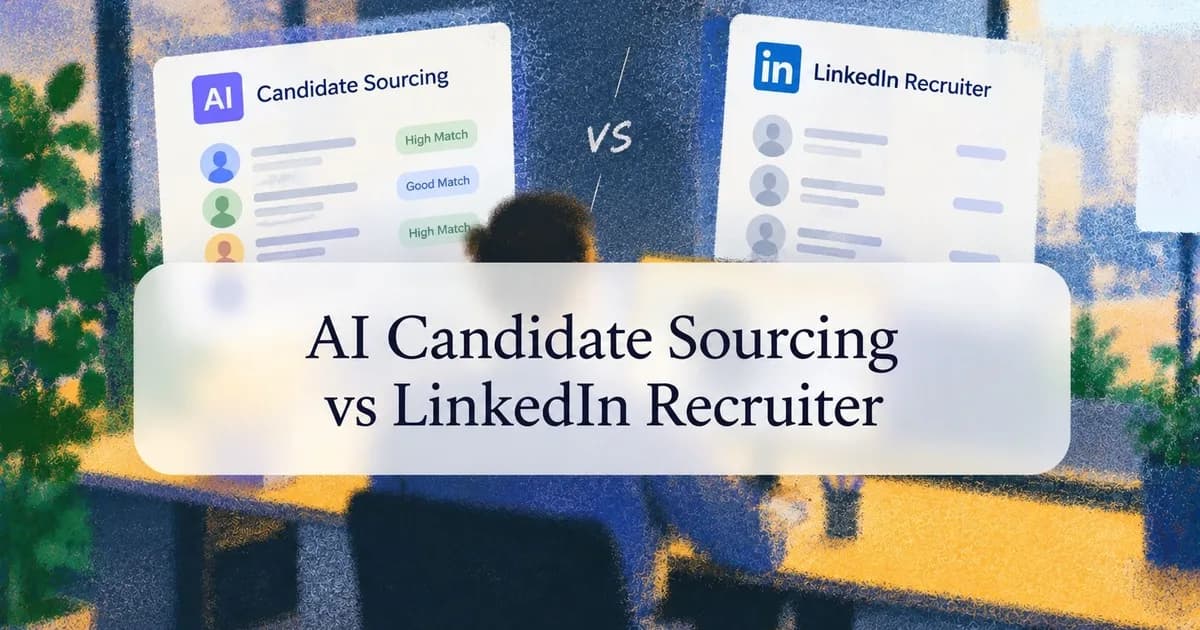
AI Candidate Sourcing vs LinkedIn Recruiter: Which Delivers Better Results?
AI candidate sourcing and LinkedIn Recruiter solve different problems. Compare how each performs on candidate discovery, passive sourcing, cost, and high-volume hiring to find the right fit for your team.
For years, the answer to a difficult sourcing problem was straightforward: open LinkedIn Recruiter, build a search, refine the filters, review profiles, and start reaching out.
For many recruiting teams, that workflow still works.
But hiring has changed.
A recruiter who once needed to find 20 candidates for one open role may now be expected to build pipelines for five, ten, or even dozens of positions at the same time. Hiring managers want shortlists faster, candidates expect more relevant communication, and lean recruiting teams are being asked to produce more hiring outcomes without necessarily getting more headcount.
That is where AI candidate sourcing enters the conversation.
Modern AI sourcing software is designed to do more than help recruiters search. It can interpret a hiring brief, identify potential candidates, evaluate role fit, prioritize profiles, and reduce the amount of manual research required before a recruiter engages someone.
At the same time, LinkedIn Recruiter has evolved considerably. LinkedIn now offers AI assisted search, Recommended Matches, AI assisted messaging, applicant management features, and more than 40 search filters, according to LinkedIn.
So the question is no longer simply whether recruiters should use LinkedIn.
The more useful question is: When does AI candidate sourcing deliver better results than traditional LinkedIn Recruiter workflows, and when does LinkedIn Recruiter still make more sense?
The answer depends on what you mean by better results.
What Is AI Candidate Sourcing?
AI candidate sourcing uses artificial intelligence to help recruiting teams discover and prioritize potential candidates based on the requirements of a role.
Traditional sourcing typically begins with a recruiter creating a search query. The recruiter chooses job titles, locations, companies, skills, seniority, industries, education, and other criteria, then reviews the resulting profiles.
AI candidate sourcing changes the starting point.
Instead of requiring recruiters to translate every hiring requirement into search filters, an AI sourcing platform can interpret the broader context of a role and use that information to identify potential matches.
For example, imagine a company is looking for a product manager who has worked in B2B SaaS, launched products for enterprise customers, managed cross functional teams, and understands a technical product environment.
A conventional search might focus on job titles and keywords.
An AI sourcing system can potentially look at the broader relationship between experience, skills, career history, role requirements, and other candidate signals.
The distinction is subtle but important.
Traditional sourcing helps you search for candidates. AI sourcing aims to help you identify candidates worth considering.
That difference becomes increasingly important as recruiting volume increases.
What is LinkedIn Recruiter?
LinkedIn Recruiter is LinkedIn's dedicated recruiting platform for finding, connecting with, and managing potential candidates. It provides access to LinkedIn's professional network, advanced search functionality, candidate recommendations, messaging tools, and recruiting workflow features. LinkedIn says its platform provides access to insights from more than one billion global members.
Its biggest strength is the scale and depth of the LinkedIn talent network.
Recruiters can search using more than 40 filters, including job titles, locations, companies, skills, schools, industries, languages, and other criteria. Boolean operators can also be used to make searches more specific.
LinkedIn has also added more AI capabilities.
Its AI assisted search allows recruiters to describe the type of candidate they want and have the system translate that request into relevant search filters. Recommended Matches can surface candidates based on hiring signals, job requirements, and other information.
This means the comparison is not really between "AI" and "LinkedIn."
LinkedIn itself is becoming more AI powered.
The more meaningful comparison is between a network centered sourcing platform and an AI first sourcing workflow.
AI Candidate Sourcing vs LinkedIn Recruiter: The Fundamental Difference
The easiest way to understand the difference is to look at what each system is primarily designed to accomplish.
Area | AI Candidate Sourcing | LinkedIn Recruiter |
Core purpose | Discover and prioritize relevant candidates | Search and engage candidates across LinkedIn |
Candidate discovery | AI driven matching and recommendations | Advanced search and recommendations |
Search approach | Context and role fit focused | Filters, keywords, Boolean and AI assisted search |
Passive sourcing | Strong focus on discovering passive talent | Strong access to LinkedIn's professional network |
Recruiter workload | Designed to reduce manual candidate research | Recruiter remains closely involved in search and review |
Candidate evaluation | Can prioritize based on role fit signals | Primarily a sourcing and engagement workflow |
Outreach | Often integrated into sourcing workflow | InMail and AI assisted messaging |
Best suited for | Teams seeking scalable candidate discovery | Recruiters who want deep access to LinkedIn talent |
Workflow | Discovery, matching and qualification | Search, shortlist and outreach |
Scale | Particularly useful for repetitive sourcing demand | Particularly powerful for targeted LinkedIn sourcing |
Neither approach automatically wins. The right choice depends on your recruiting model.
Where LinkedIn Recruiter Still Has a Major Advantage
It would be a mistake to treat LinkedIn Recruiter as outdated simply because AI sourcing is growing.
LinkedIn's biggest advantage is its enormous professional network and the amount of information available within that ecosystem.
If you know exactly what you are looking for, LinkedIn Recruiter can be extremely powerful.
A recruiter searching for a senior cybersecurity professional in Munich with specific technical skills, experience at particular companies, and a certain level of seniority can construct a highly targeted search using LinkedIn's filters.
Recruiters can also use Boolean search, save searches, revisit previous searches, organize candidates into projects, and use Spotlights to prioritize people who may be more receptive to outreach.
The platform is particularly useful when recruiters already have strong sourcing expertise.
An experienced sourcer knows how to construct searches, identify alternative job titles, recognize relevant companies, experiment with keywords, and interpret profiles.
In that scenario, LinkedIn Recruiter becomes an extremely capable sourcing environment.
Its AI features make that workflow even faster.
Where AI Candidate Sourcing Starts to Pull Ahead
The biggest advantage of AI candidate sourcing becomes visible when the recruiter doesn't simply need access to candidates.
They need candidate prioritization at scale.
Consider a company hiring 50 sales representatives across multiple locations.
The problem isn't whether a recruiter can search for sales professionals.
They can.
The problem is how much time it takes to evaluate hundreds or thousands of potentially relevant profiles, determine who fits the actual role, identify transferable experience, and decide who should receive attention first.
This is where AI sourcing can create leverage.
Instead of treating every profile as another search result, AI can help narrow the recruiter's attention toward stronger potential matches.
For lean recruiting teams, this distinction can be significant.
The recruiter spends less time asking: "Who should I search for?"
and more time asking: "Which of these candidates should I engage?"
That is a much more valuable use of recruiter expertise.
AI Sourcing Is Particularly Powerful for Passive Candidates
Passive candidates are one of the strongest reasons companies invest in sourcing technology.
These candidates aren't necessarily browsing job boards or actively applying for positions. They may already have a good job and only consider moving if an opportunity is particularly relevant.
Finding them requires proactive sourcing.
LinkedIn Recruiter is naturally strong here because LinkedIn is a large professional network and provides numerous ways to identify potential candidates, including filters for open to work status, skills, companies, seniority, location, and other attributes, according to LinkedIn.
AI candidate sourcing adds another layer by focusing on matching and prioritization.
Instead of simply asking whether someone matches a search query, the objective becomes understanding whether their broader experience appears relevant to the role.
This can be especially valuable for roles where traditional keyword matching is insufficient.
Think about a candidate whose official title is "Growth Lead" but whose experience includes product marketing, demand generation, experimentation, analytics, and ownership of a substantial acquisition funnel.
A rigid search may miss the person.
A more context aware sourcing system may recognize the relationship between that experience and the requirements of a growth leadership position.
That is where AI can expand the talent pool rather than simply search it.
The Real Cost of LinkedIn Recruiter Isn't the Subscription
When companies compare AI sourcing software with LinkedIn Recruiter, they often focus on subscription price.
That is only part of the equation.
The bigger cost is recruiter time.
Imagine a recruiter spends two hours building a search, another three hours reviewing profiles, another two hours creating a shortlist, and another few hours preparing outreach.
The software hasn't necessarily failed.
The recruiter is using the software exactly as designed.
But the company is still paying for significant human effort.
This becomes particularly important in high volume hiring.
If a team has ten open roles, manual sourcing may be manageable.
If it has 100 open roles, the same workflow can become a serious capacity constraint.
This is why companies should evaluate sourcing tools using cost per qualified candidate, time to shortlist, and recruiter hours per qualified candidate, rather than simply looking at the software subscription.
A cheaper tool that requires significantly more recruiter effort may ultimately be the more expensive solution.
Which Produces Better Candidate Quality?
This is where the answer becomes more nuanced.
LinkedIn Recruiter gives recruiters tremendous control over search criteria. That can produce highly relevant candidates when the recruiter knows exactly which signals to look for.
AI candidate sourcing can potentially improve candidate discovery when the definition of fit is more complex.
The key is how "fit" is defined.
If the role has very straightforward requirements, traditional search can work exceptionally well.
If the role requires a combination of transferable skills, career progression, adjacent experience, industry knowledge, and contextual signals, AI matching may provide more value.
However, no sourcing technology should be treated as an automatic guarantee of candidate quality.
AI recommendations still need human review.
A candidate who looks like an excellent match on paper may not be interested in moving. Another candidate may have an unconventional background that makes them excellent for the role despite not matching the obvious criteria.
The best sourcing systems therefore don't remove human judgment.
They help recruiters apply it more efficiently.
What About Outreach?
Candidate discovery is only half the sourcing equation.
Once candidates are identified, recruiters need to engage them.
LinkedIn Recruiter has a major advantage here because sourcing and InMail are tightly connected. Recruiters can identify candidates and contact them within the same ecosystem. LinkedIn also offers AI assisted messaging that can help personalize messages based on candidate profiles and job requirements.
AI sourcing platforms can also support outreach, depending on the product and workflow.
But this is an area where recruiters should be careful.
Automation can increase the number of people contacted.
It doesn't automatically increase the quality of the conversation.
The strongest recruiting outreach still needs relevance, context, and authenticity.
AI should help recruiters understand why a candidate is a good match and make the engagement process more efficient.
It should not turn sourcing into a mass messaging exercise.
Which Is Better for High Volume Hiring?
This is where the difference becomes most obvious.
For high volume hiring, the bottleneck isn't usually the ability to search.
It is the ability to maintain candidate flow without overwhelming the recruiting team.
Imagine a company hiring across sales, customer support, operations, and technical roles simultaneously.
A recruiter using LinkedIn Recruiter may be able to create excellent searches for each role. But every additional role creates another search, another candidate list, another review process, and another outreach workflow.
AI candidate sourcing can help by creating a more scalable discovery and prioritization layer.
This is particularly valuable for:
• Startups and scaleups
• High volume hiring teams
• Lean HR teams
• Staffing and recruiting agencies
• Companies hiring across multiple locations
• Teams recruiting for repetitive roles
• Companies building passive talent pipelines
For these organizations, the question is not simply whether a recruiter can source candidates.
It is whether the sourcing system can keep producing relevant candidates without requiring recruiter workload to increase at the same rate as hiring demand.
AI Candidate Sourcing vs LinkedIn Recruiter: Which Should You Choose?
There isn't one universal winner.
Choose LinkedIn Recruiter when your priority is deep access to LinkedIn's professional network, precise search control, recruiter led sourcing, and direct candidate engagement through LinkedIn.
It remains a powerful option for experienced sourcers who know how to construct searches and want extensive control over the talent discovery process.
Choose AI candidate sourcing when your priority is reducing manual research, improving candidate matching, expanding sourcing capacity, and allowing a smaller recruiting team to manage more hiring demand.
For many organizations, however, the smartest answer isn't choosing one or the other.
It is using them for different jobs.
LinkedIn can remain an important talent source while AI becomes the intelligence layer that helps recruiters discover, prioritize, and qualify candidates more efficiently.
The future of sourcing is unlikely to be about eliminating every traditional recruiting tool.
It is about making the entire sourcing workflow more intelligent.
The Next Generation of Candidate Sourcing is About Prioritization
Recruiting technology has historically been very good at storing information.
Then it became good at searching information.
Now the industry is moving toward systems that can interpret information and recommend actions.
That is a much bigger shift.
A recruiter doesn't ultimately need 5,000 candidate profiles.
They need to know which 20 people are worth talking to.
They don't need another database.
They need better candidate flow.
They don't necessarily need to spend another afternoon refining Boolean strings.
They need more time to understand candidates, influence hiring managers, and close great people.
That's the real promise of AI candidate sourcing.
Not replacing the recruiter.
Replacing unnecessary recruiter effort.
And that is why the most important comparison isn't really AI candidate sourcing versus LinkedIn Recruiter.
It is: How much valuable recruiting work can your sourcing technology remove without reducing the quality of your hiring decisions?
For teams hiring at scale, that is the metric that matters.
FAQs
Is AI candidate sourcing better than LinkedIn Recruiter?
AI candidate sourcing can be better when the primary need is automated candidate discovery, matching, prioritization, and scalable sourcing. LinkedIn Recruiter remains highly effective for recruiters who need deep access to LinkedIn's professional network and precise search controls. The best choice depends on the team's hiring volume and sourcing workflow.
Can AI sourcing replace LinkedIn Recruiter?
AI sourcing does not necessarily replace LinkedIn Recruiter. Many recruiting teams can use both approaches as complementary parts of their sourcing strategy. LinkedIn can provide access to a large professional talent network, while AI sourcing can help reduce manual research and prioritize candidates based on role fit.
What is the difference between AI candidate sourcing and LinkedIn Recruiter?
The main difference is the operating model. LinkedIn Recruiter is primarily a professional network and recruiting search platform with advanced filters, recommendations, and messaging. AI candidate sourcing focuses more heavily on using artificial intelligence to discover, match, evaluate, and prioritize candidates based on the broader context of a hiring requirement.
Is AI candidate sourcing useful for passive recruiting?
Yes. AI candidate sourcing can be particularly useful for passive recruiting because it can help identify professionals who may not be actively applying for jobs. This allows recruiters to expand beyond inbound applicants and build proactive candidate pipelines.
Which is better for high volume hiring?
AI candidate sourcing can provide greater leverage for high volume hiring because it is designed to reduce repetitive candidate research and prioritization work. LinkedIn Recruiter remains valuable as a sourcing channel, particularly when recruiters need precise control over searches and direct access to LinkedIn's professional network.
What should recruiters measure when comparing sourcing tools?
Recruiters should look beyond the number of profiles found. Useful metrics include time to shortlist, qualified candidate rate, response rate, sourcing to interview conversion, recruiter hours per qualified candidate, cost per qualified candidate, and ultimately quality of hire.
Read more
AI Recruiting
15 Recruitment Metrics Every Hiring Team Should Track in 2026
A complete framework of 15 recruitment metrics covering speed, efficiency, cost, quality, candidate experience, and pipeline health, and how AI recruiting is changing what good measurement looks like in 2026.
Candidate Interview
How AI Interview Agents Reduce Time-to-Hire Without Sacrificing Candidate Experience
AI interview agents remove the scheduling and coordination friction that slows hiring down, helping teams cut time-to-hire while giving candidates a faster, more responsive experience.

Candidate Sourcing
10 Candidate Sourcing Strategies That Actually Work in 2027
10 candidate sourcing strategies for 2027, from building talent pipelines before roles open to using AI for prioritization, passive candidate engagement, and measuring sourcing quality over activity.