Industry Insights & Trends
October 7, 2026
The Future of AI in Recruiting: Insights From HR Experts
26 HR leaders, TA directors, staffing founders, and CEOs share how AI will reshape recruiting over the next two to three years, from candidate screening to final hiring decisions.
AI will not replace recruiters in the next few years, but it will change almost everything about how they spend their time. Resume screening is shrinking from days to minutes. Candidates are using the same tools to polish every application. And the real question for hiring teams is shifting from "How do we find people?" to "How do we know who can actually do the job?"
To understand where recruiting is headed, we asked HR leaders, talent acquisition directors, staffing founders, and CEOs one question: How will AI change recruiting over the next two to three years?
We heard from 25+ experts. Their answers agree on more than you might expect: AI should take over the admin, humans should keep the decision, and the resume is losing its place at the center of hiring. But they also surface less obvious ideas, from rediscovering past applicants to using AI to get new hires productive in weeks instead of months.
Here is what they told us.
Expert insights on the future of AI in recruiting
1. Use AI to remove admin, not human judgment
Dieter Blom, Director at Versys Media | LinkedIn
"The biggest shift will be in early-stage candidate evaluation. Recruiting teams will spend far less time manually screening CVs and far more time validating fit, communication, and real problem-solving ability, because the first layer of filtering will be handled at speed and at scale.
The teams getting this right use AI to remove admin, tighten screening logic, and improve response times, while keeping final shortlisting and culture-fit decisions firmly with experienced recruiters. The risk is over-automation. Once hiring teams start treating pattern matching as decision-making, they lose nuance and miss strong candidates who don't fit a clean data profile. The future isn't AI replacing recruiters. It's recruiters with better systems making sharper calls."
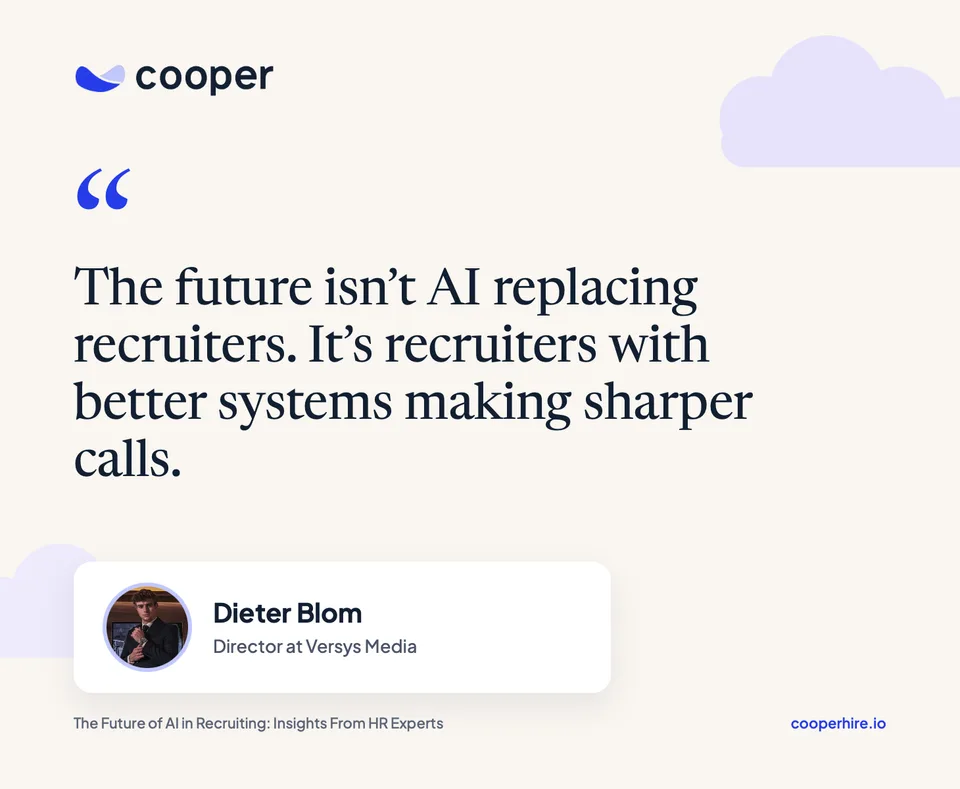
Takeaway: Faster screening raises the bar for process design. Automate the admin, and protect the judgment calls.
2. Compete on interview depth, not CV speed
Chris Coussons, Founder at Visionary Marketing | LinkedIn
"AI will collapse first-pass CV screening to minutes. The agencies that win will compete on interview depth and trial tasks instead."
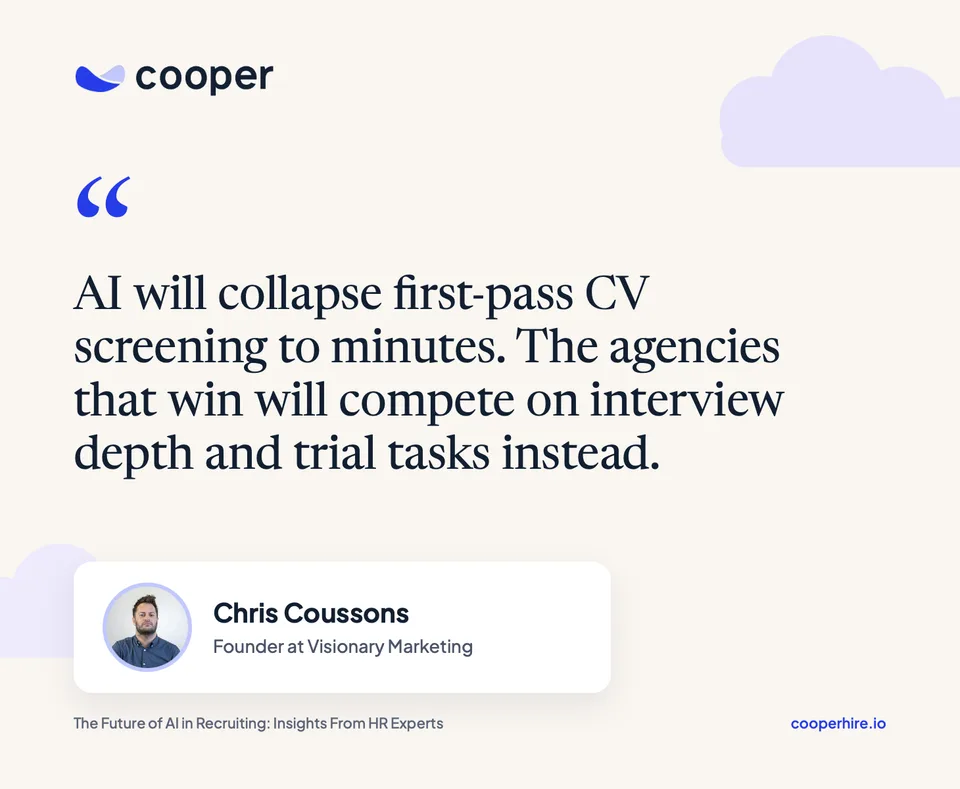
Takeaway: When everyone screens at the same speed, the advantage moves to how well you assess people.
3. Rank applicants, but check the outliers
Aaron Whittaker, Thrive Internet Marketing Agency | LinkedIn
"Within a few years, AI will transform initial candidate screening. A recruiter facing 300 applications will no longer need to review them in a rigid sequence. AI can rank applicants against the role's required skills and experience, so the recruiter can review the strongest matches first. The recruiter can then check lower-ranked candidates whose transferable experience or nontraditional career paths may score poorly against the stated criteria."
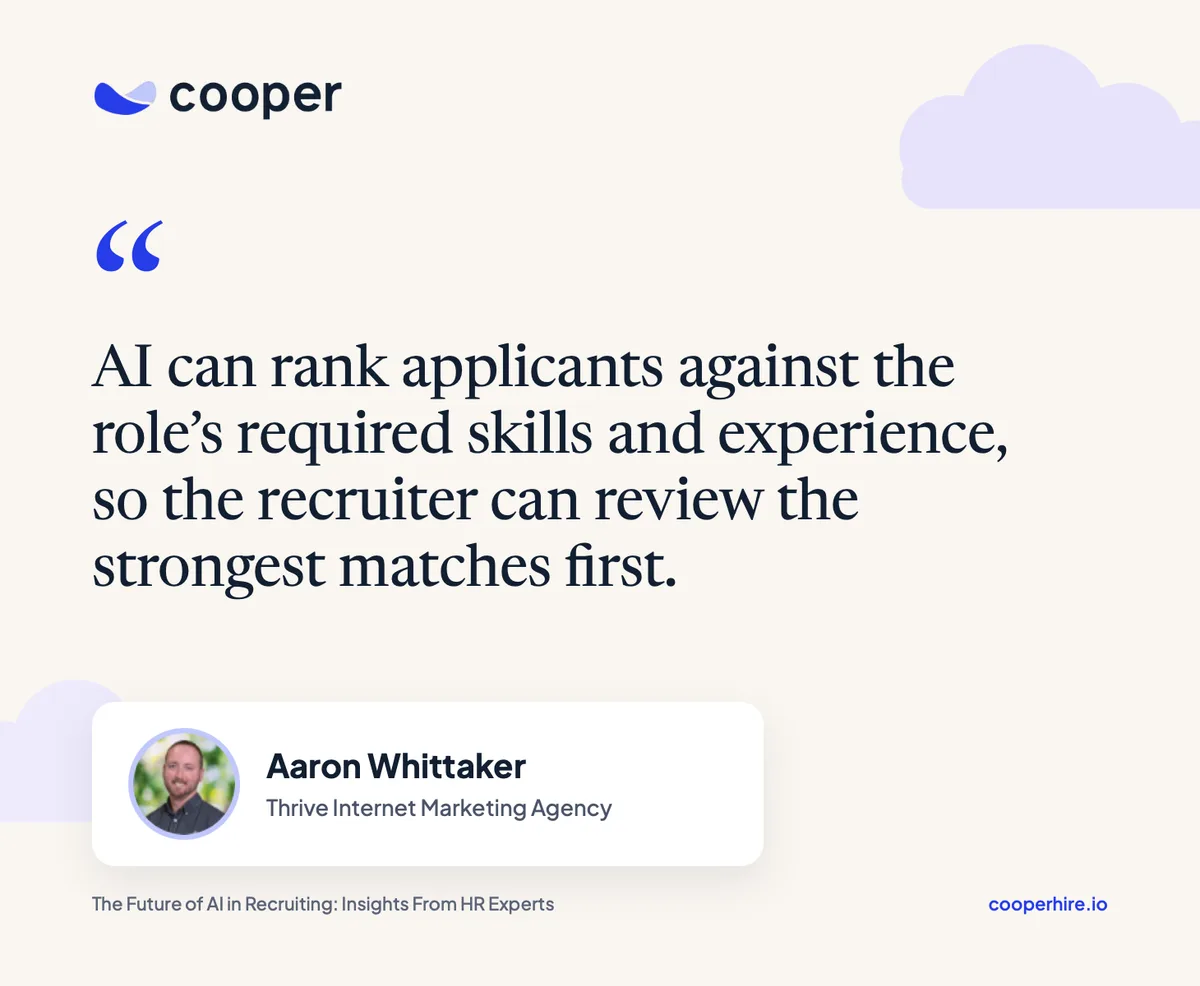
Takeaway: Let AI set the reading order, but keep a human eye on candidates the ranking might undervalue.
4. Screen for skills and behavioral fit, not keywords
Nicolas Falourd, Founder & CEO at Cyber Techwear | LinkedIn
"Over the next two to three years, AI will automate initial candidate screening in a way that prioritizes skills and behavioral fit rather than keywords. Hiring teams will spend more time interviewing higher-quality matches and less time on administrative filtering. In e-commerce and niche communities, AI-driven screening is already helping surface cultural fit and transferable skills."
Takeaway: The next generation of screening looks at what candidates can do, not which words they used.
5. Predict fit from real performance data
Jean-Christophe Thery, Founder at MusaArtGallery | LinkedIn
"AI will shift screening from keyword matching to behavioral-fit prediction. By combining interview transcripts, work-sample results, and past hiring outcomes, AI will flag candidates whose problem-solving style and communication patterns match a role's proven performers. That reduces time-to-hire while improving on-the-job fit."
Takeaway: Your own hiring history, from interviews to work samples to outcomes, is the best training data for spotting future top performers.
6. Surface soft skills earlier
Bradford R. Glaser, President & CEO at HRDQ | LinkedIn
"AI will take over resume screening and initial matching, freeing recruiters to focus on real conversations and judgment calls. The bigger opportunity is using AI to identify soft skills like communication and teamwork early, so companies hire for fit as well as experience."
Takeaway: Communication and teamwork usually surface late in the process. AI can bring them forward.
7. The resume stops being what gets screened
Alon Pearl, Founder & CEO at VA Masters | LinkedIn
"Within the next two to three years, I expect the resume to stop being the thing that gets screened. When anyone can generate a flawless, keyword-optimized application in seconds, everyone looks exceptional on paper. Hiring has to move to a short practical task where you can actually watch how someone thinks."
Takeaway: A short, practical task will tell you more than a perfect resume.
8. Keyword filters are losing their value
Connor Gross, CEO at Constant Hire | LinkedIn
"Companies use AI to scan resumes for specific keywords. In response, candidates are using AI to build their resumes and fill them with those same keywords, which gets them through what used to be a more demanding process. As a result, these filters will become less relevant. Candidates will also feel less inclined to apply for jobs with a thousand other applicants, knowing that hiring managers can't properly sort through them."
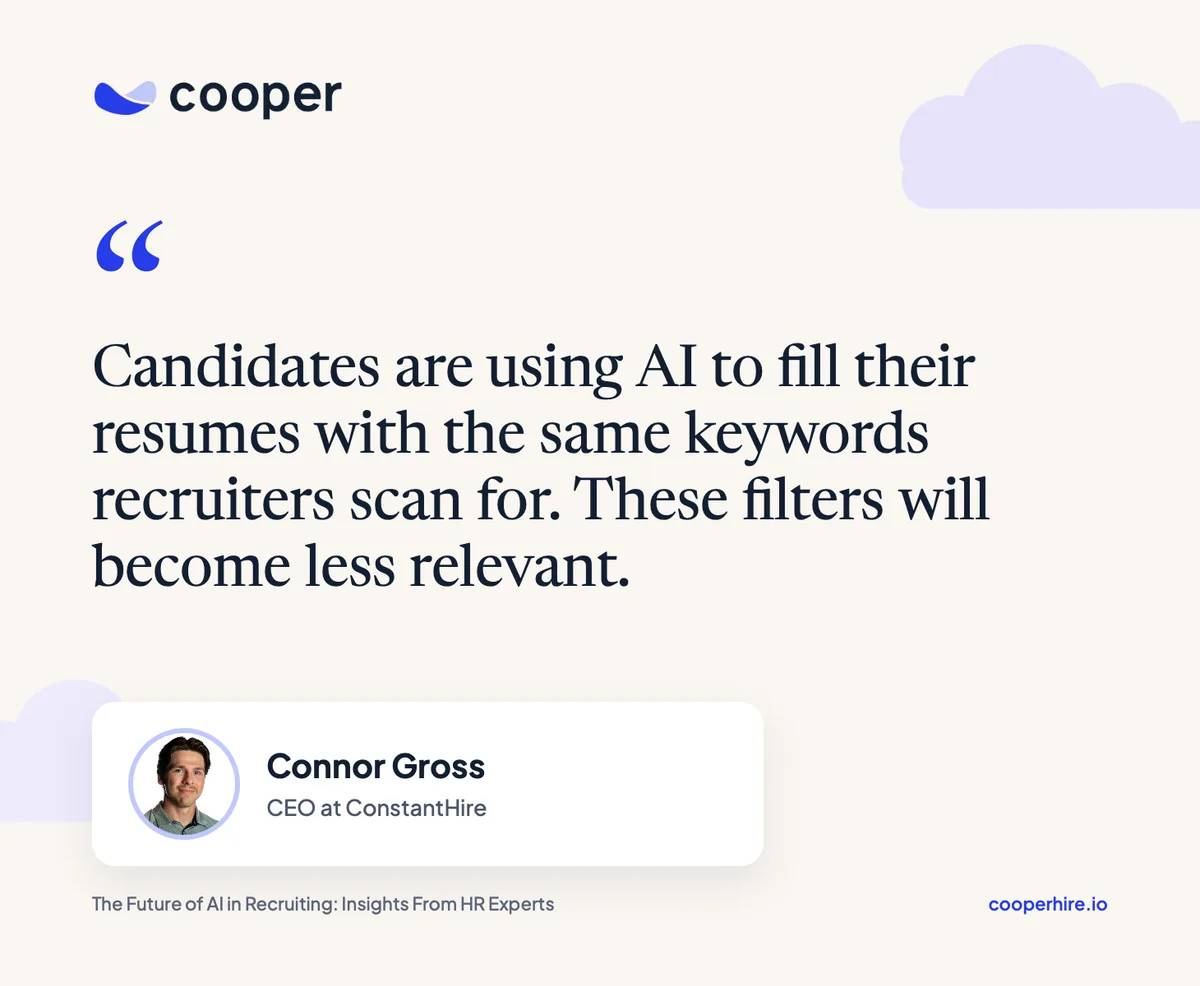
Takeaway: Keyword matching is a game both sides can now win, so it no longer separates strong candidates from weak ones.
9. The interview matters more than ever
Nick Anisimov, Founder at FirstHR | LinkedIn
"AI is turning hiring into an arms race. Candidates use AI to polish applications and pass screening, while recruiters rely on AI tools that quietly filter out strong candidates over a resume format or an incomplete LinkedIn profile. My prediction is that the interview itself becomes more important than ever, since AI can fake almost everything that comes before it."
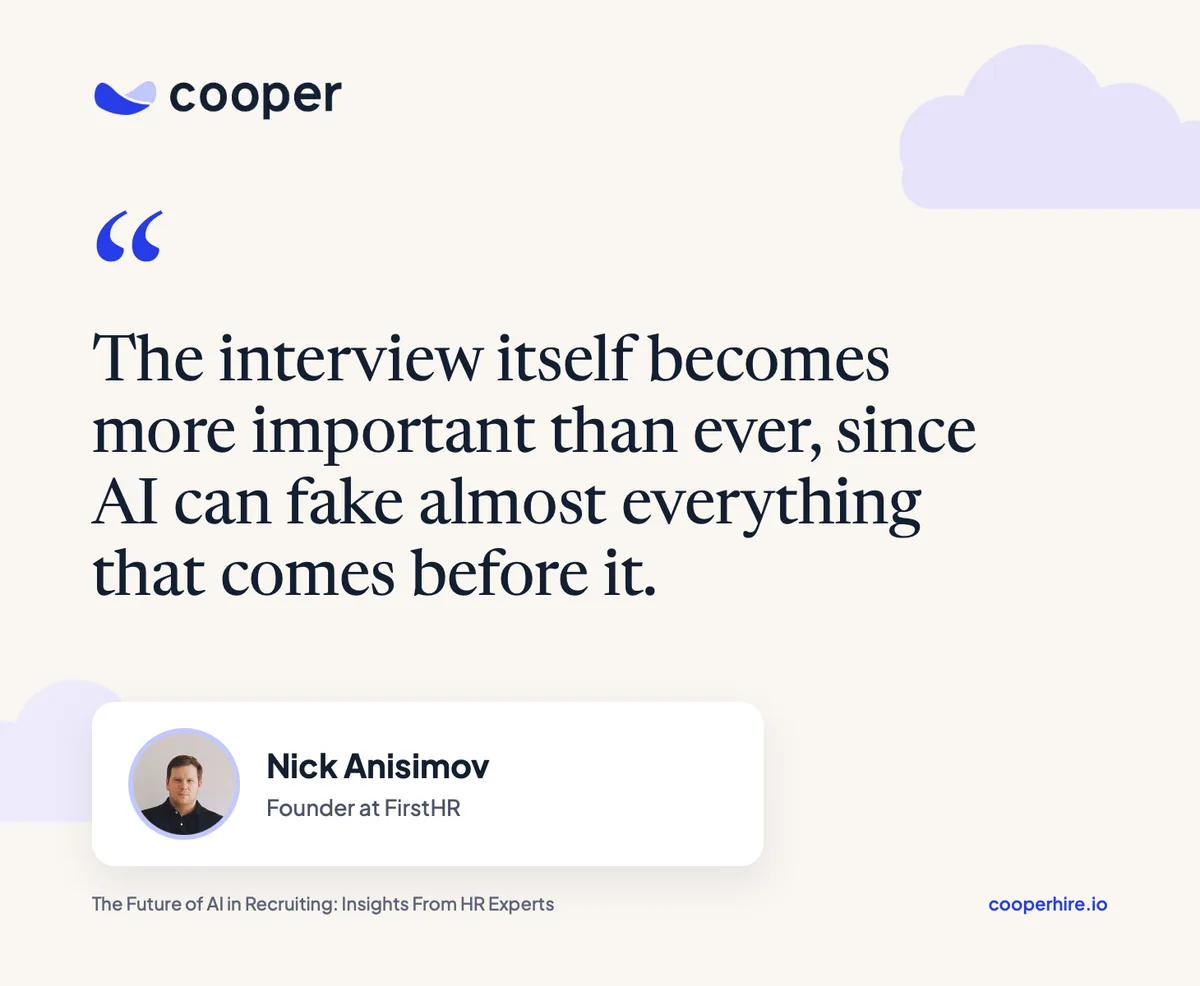
Takeaway: Invest in structured, well-designed interviews. They are becoming the most reliable signal you have.
10. Verify ability, not polished answers
Sergio Ermacora, Co-Founder & COO at Nexteam | LinkedIn
"Over the next two to three years, I expect AI to shift recruiting's biggest challenge from finding candidates to verifying what they can actually do, as polished applications and technically correct answers become easier to produce. In finance and accounting hiring, the differentiator will be asking candidates to explain their assumptions, identify missing information, and adapt when an input changes, not simply submit a convincing final answer."
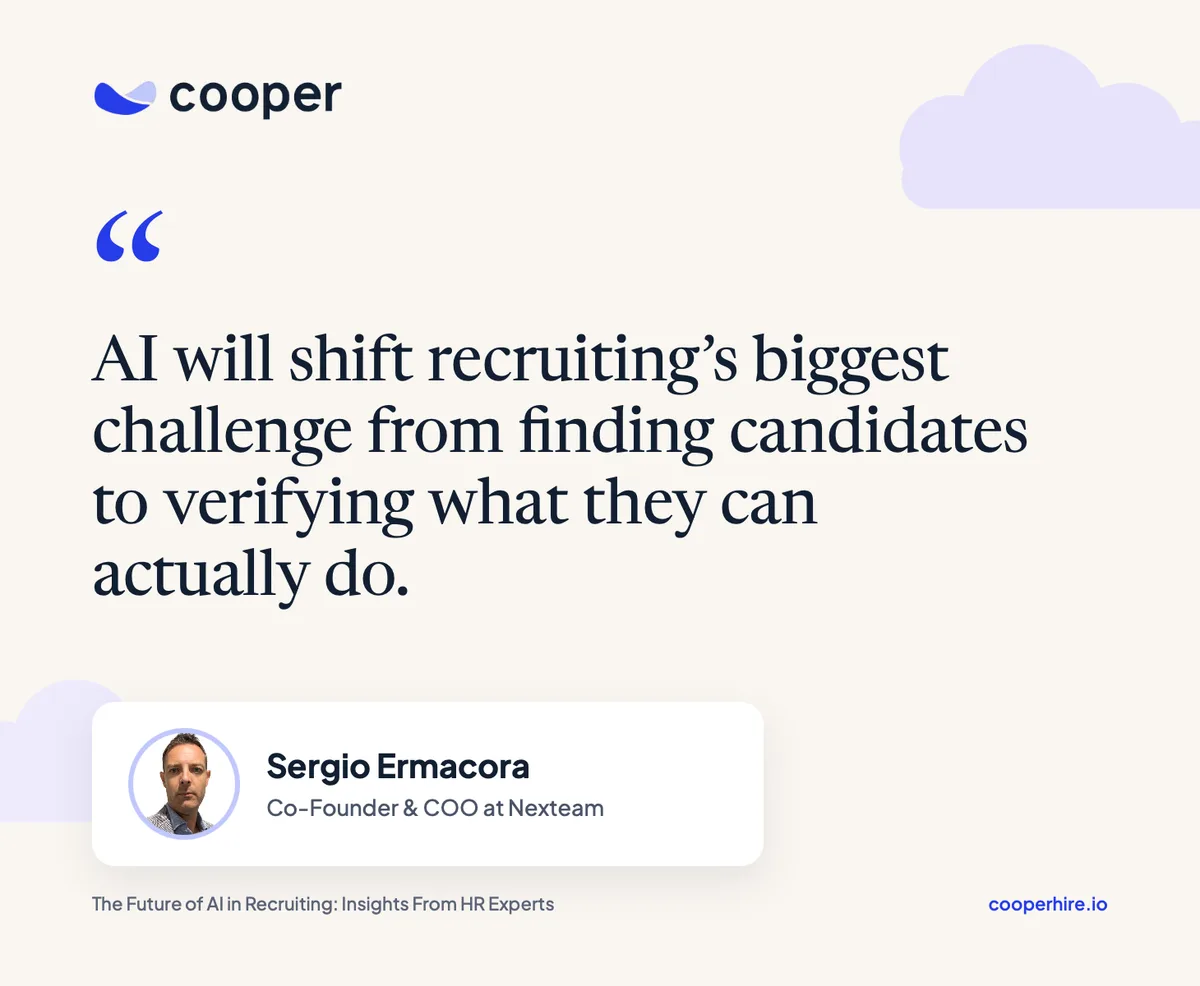
Takeaway: Ask candidates to show their reasoning. How they get to an answer is harder to fake than the answer itself.
11. Recruiter judgment grows in value
María José Lorenzo, Director of Talent Acquisition at Hire With Near | LinkedIn
"I think a recruiter's judgment and critical thinking will become even more valuable. The tools to fake a profile or get live help during an interview will only get easier to access. We will need recruiters who can see past AI use and who never skip the human touchpoints that verify a candidate's skills and credentials."
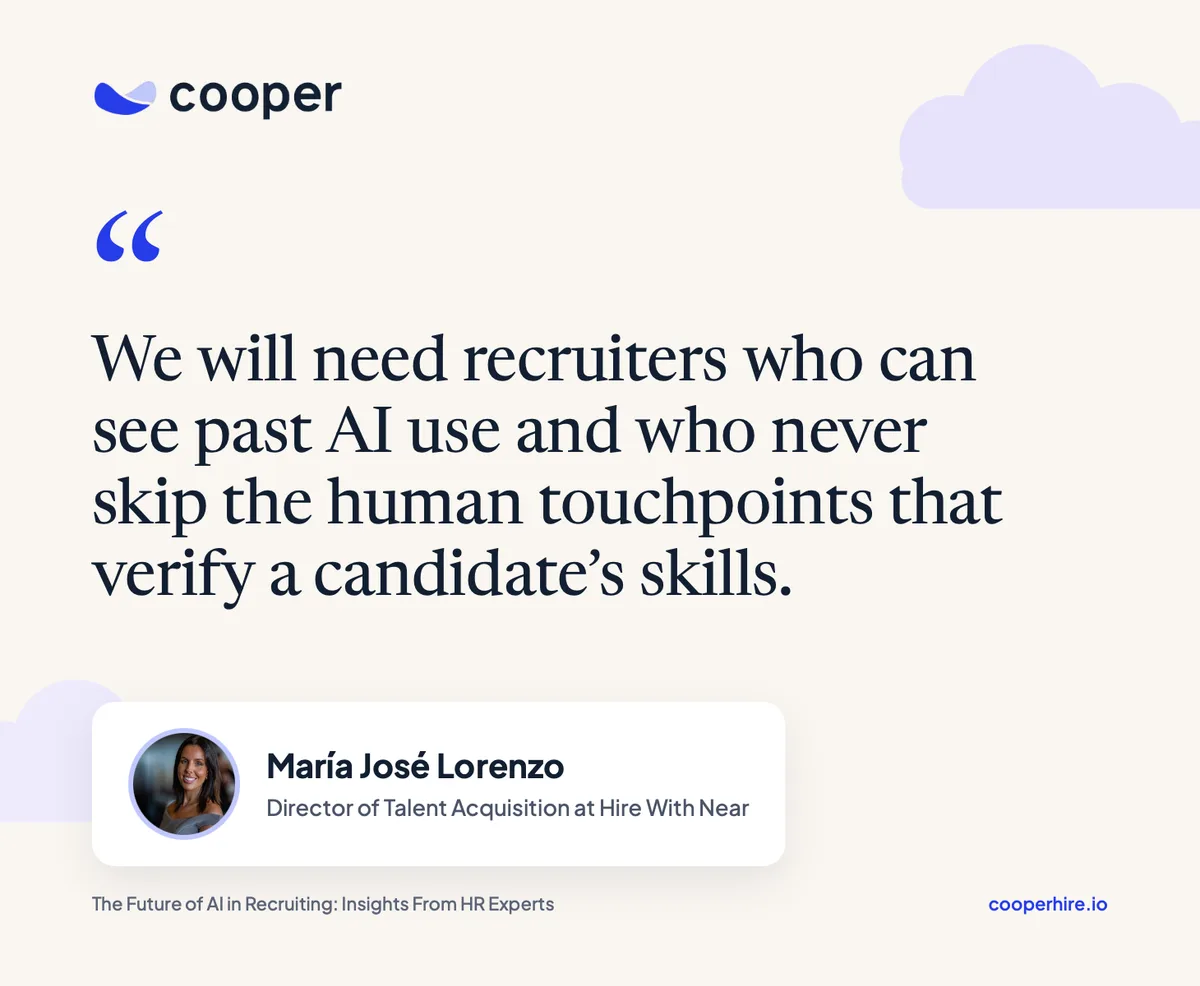
Takeaway: As faking gets easier, human verification becomes a core recruiting skill.
12. Define strong performance before hiring begins
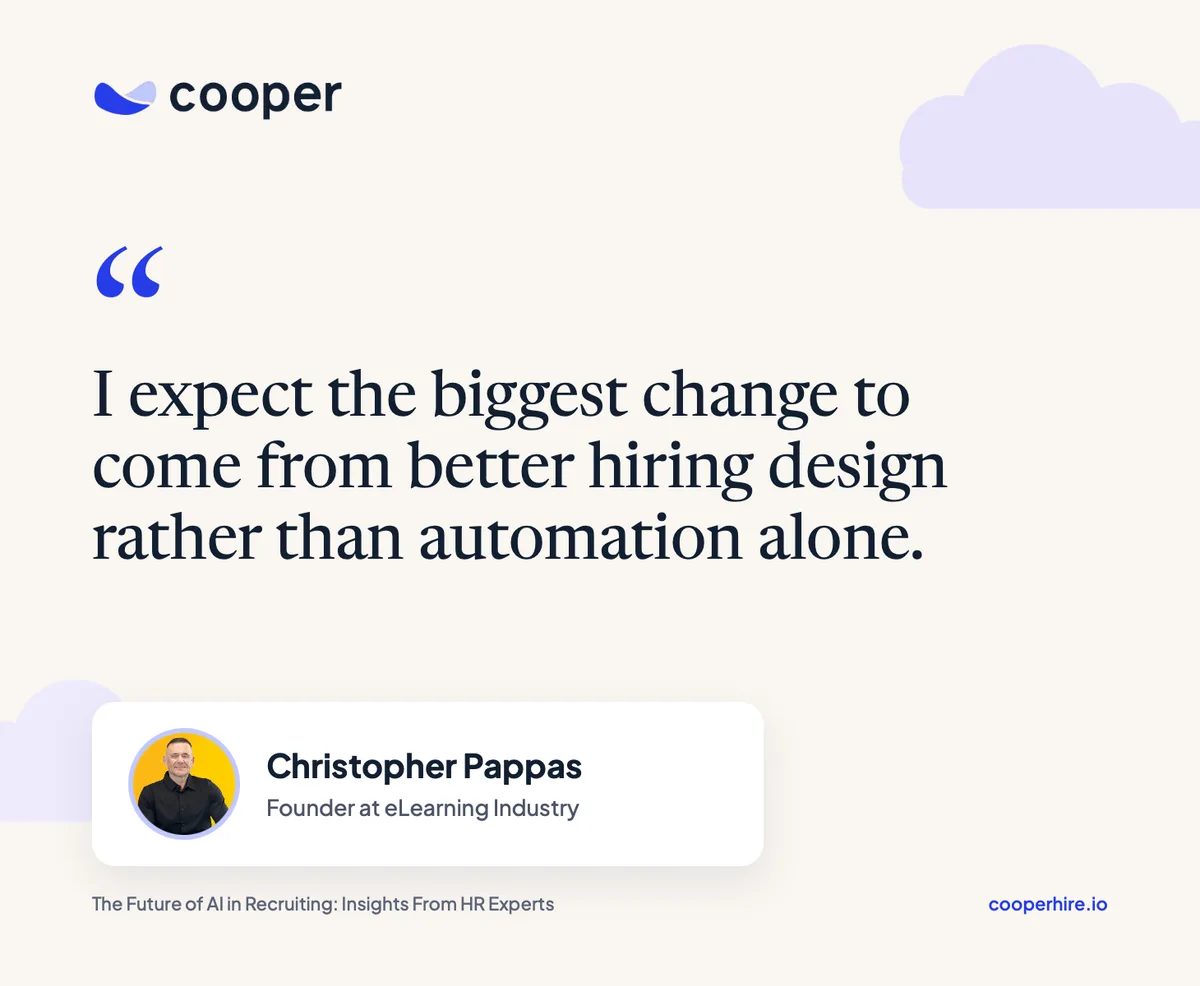
Christopher Pappas, Founder at eLearning Industry | LinkedIn
"AI will change recruiting by pushing employers to define strong performance before hiring begins. We can no longer rely on generic job descriptions or broad requirements. We need clear skills, expected outcomes, and behavioral standards for every role, which creates a stronger foundation for fair and consistent hiring decisions.
We also use AI to uncover gaps in the hiring process early. We can see when interviewers apply different standards, or when requirements don't match the real work. Agreeing on evidence before candidates enter the process leads to better decisions. I expect the biggest change to come from better hiring design rather than automation alone."
Takeaway: AI is only as good as the criteria you give it. Define what "great" looks like before you open the role.
13. Clear criteria keep managers in charge
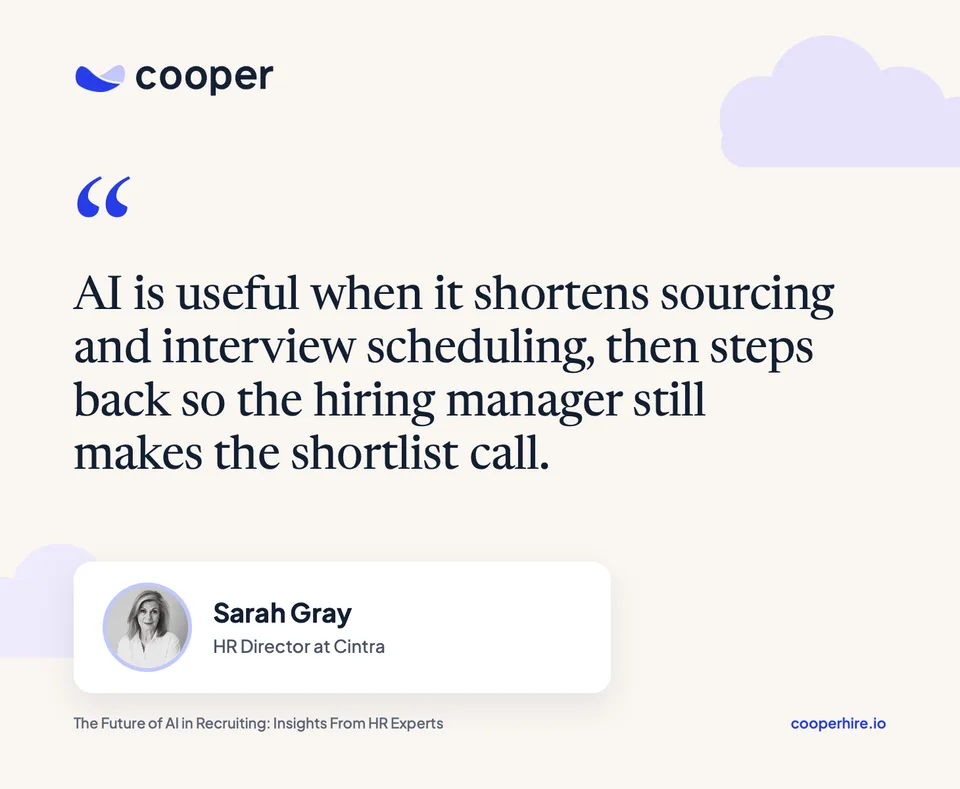
Sarah Gray, HR Director at Cintra | LinkedIn
"Over the next two to three years, AI will speed up screening and scheduling, but the lasting change will be clearer hiring criteria, so managers still own the decision. In our own hiring at Cintra, AI is useful when it shortens sourcing and interview scheduling, then steps back so the hiring manager still makes the shortlist call."
Takeaway: Decide in advance where AI stops. For Cintra, that line is the shortlist.
14. More time for relationships and oversight
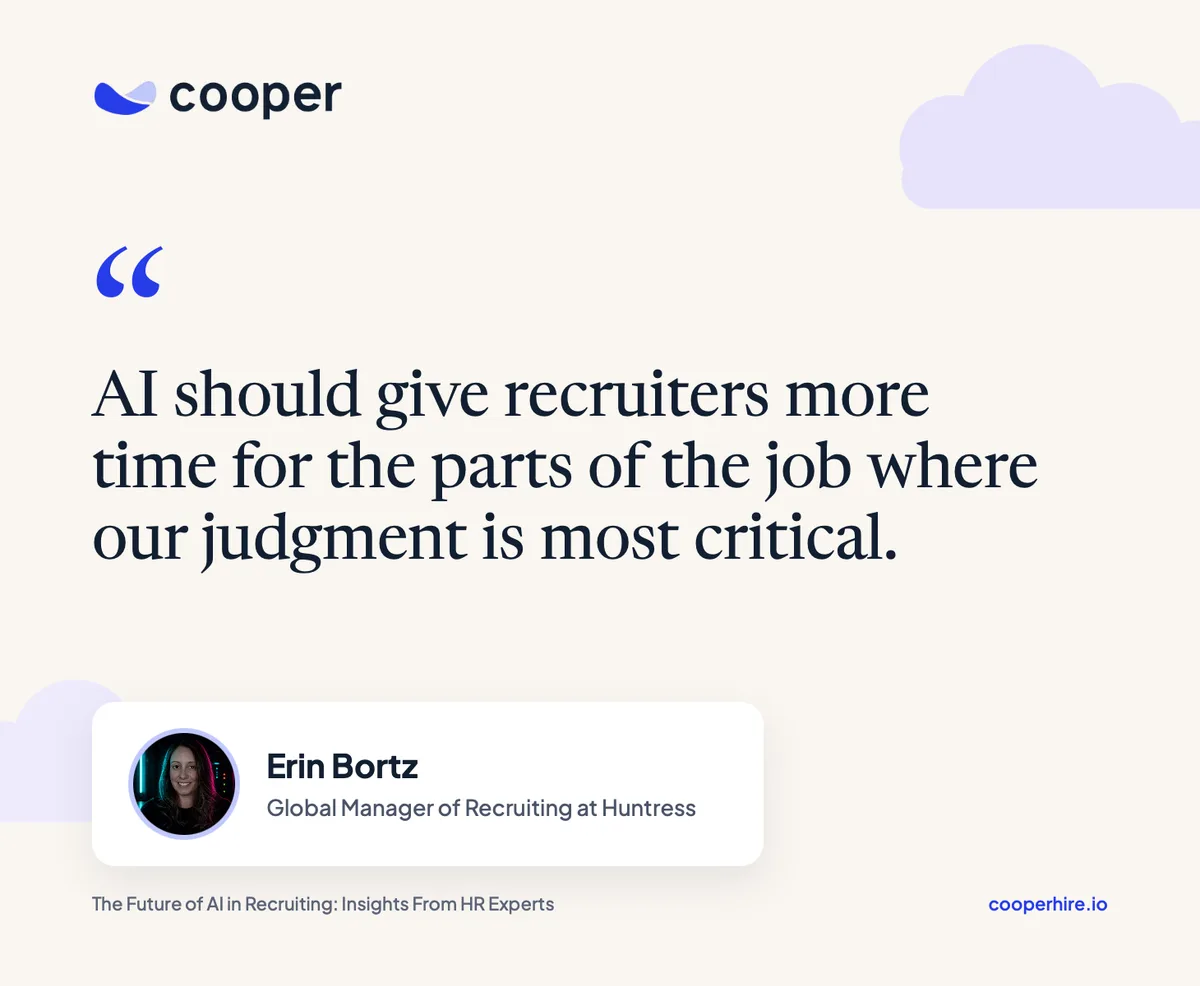
Erin Bortz, Global Manager of Recruiting at Huntress | LinkedIn
"Over the next few years, AI will keep taking over the most transactional side of recruiting, with the biggest impact on tasks like reviewing applications, organizing information, and highlighting potential candidates. That should give recruiters more time for the parts of the job where our judgment is most critical: building relationships, understanding the needs of hiring teams, and providing genuine human oversight."
Takeaway: The time AI saves should go straight into relationships with candidates and hiring managers.
15. AI widens the talent pool; humans handle the nuance
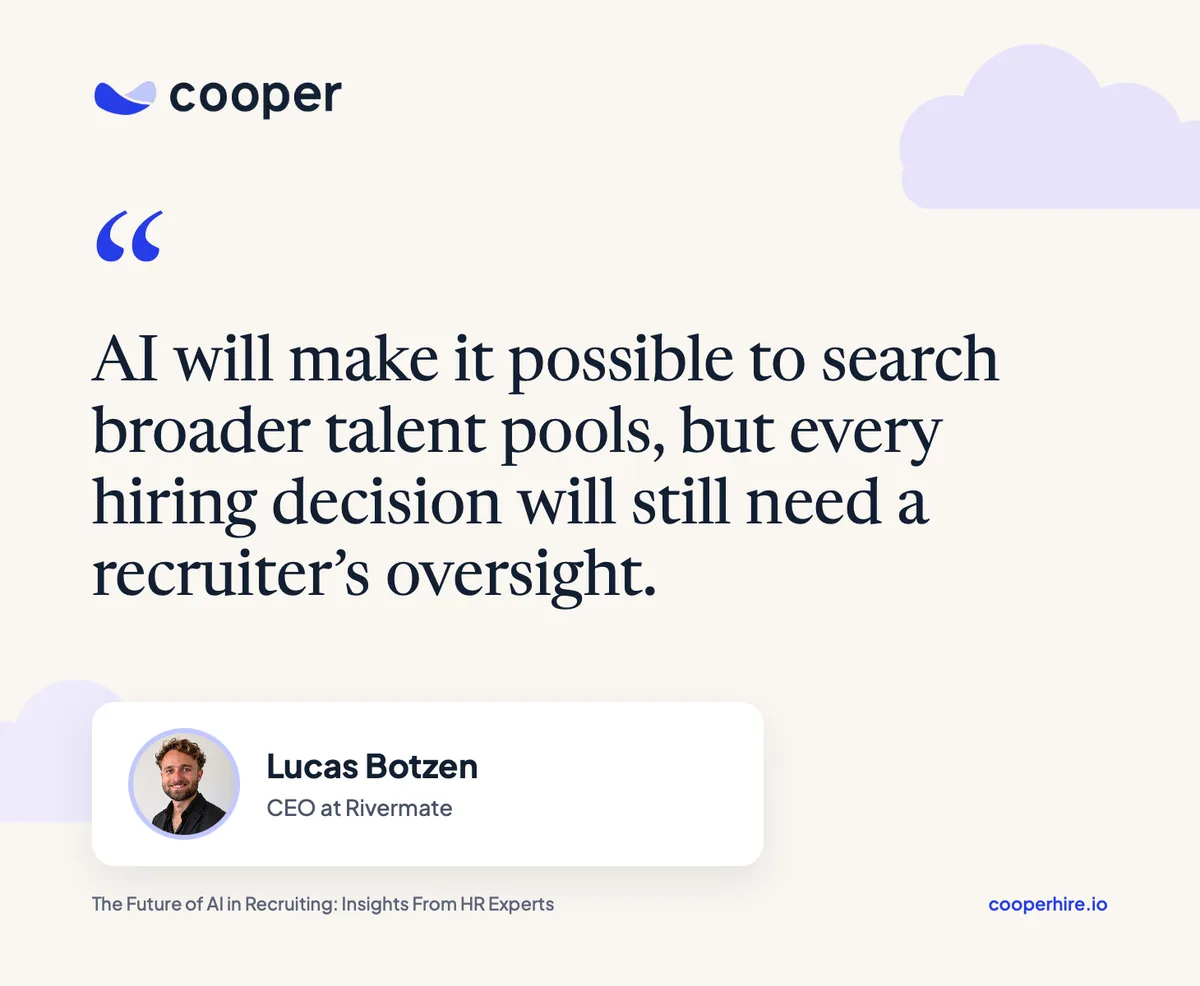
Lucas Botzen, CEO at Rivermate and global employment specialist | LinkedIn
"AI's biggest positive impact on recruiting will come from automating routine administrative tasks. That gives recruiters more time for the work where they add the most value: understanding candidates' motivations, building trust, evaluating qualifications, and advising hiring managers.
Stronger recruiting teams will use AI-driven data analysis to find bottlenecks in their hiring funnel, reduce time-to-hire, and personalize candidate interactions, while always keeping a human in charge of the final decision. For global employers, AI will make it possible to search broader talent pools and manage data across multiple countries. But every hiring decision will still need a recruiter's oversight, because automated systems can't handle the nuances of local labor laws, culture, candidate experience, and bias."
Takeaway: Global hiring gets easier with AI, but compliance and culture still require human expertise.
16. Use AI to widen the pool, not just speed up the funnel
Aden Ritz, USA Growth Partner at VirtuHire | LinkedIn
"AI is changing what recruiters spend their time on, not whether they're needed. Across 750+ offshore placements, the bottleneck was never sourcing resumes. It was screening for fit and handling replacements when a hire didn't work out. AI speeds up the first part: matching, scheduling, and initial screens. It hasn't touched the second part, which is where the real judgment and risk sit.
The firms getting the most out of AI in recruiting are using it to widen the candidate pool, including looking beyond local or US-only talent, rather than just automating the same funnel faster."
Takeaway: The biggest gains come from reaching new talent, not from running the old process faster.
17. The final decision stays with people
Eli Itzhaki, Founder & CEO at Keyzoo | LinkedIn
"AI should be used in recruiting to eliminate the administrative burden while ensuring that the final selection decision, the one truly critical decision in the process, is made by people, not AI. That is the approach I have taken while building Keyzoo into a technology-driven company. AI organizes information, reduces admin, and helps people streamline hiring, while they keep full control over the final decision."
Takeaway: Treat AI as the organizer of the process, never the decision-maker.
18. Empathy and judgment become more vital
Cyrus Kennedy, CEO at The Ad Firm | LinkedIn
"AI will improve recruiting by helping recruiters get the most relevant information about applicants, while making sure the most critical hiring decisions are still made by people. In my experience, personnel decisions have the greatest impact on a business. So while AI can make recruiting faster and easier, human qualities such as empathy, leadership, and judgment will be vital in the years ahead.
The biggest change will come from new technologies taking over the routine parts of the process. That frees professionals to focus on the human-centered side of the job, which will matter more than ever."
Takeaway: People decisions shape the business more than any other, and they still need a human touch.
19. Past candidates become future hires
Guillermo Triana, Principal Consultant & CEO at PEO-Marketplace.com | LinkedIn
"I have very high confidence that within 24 to 36 months, AI will make previously considered candidates an important source of future hires. AI lets recruiters revisit past candidates' skills against a new job description, rather than treating a rejection as a closed file. A single hiring decision can't capture a company's full budget or the needs of every role in the organization. AI can match a candidate's strengths to a different role where they are a strong fit.
The biggest upside isn't replacing people with machines. It's helping teams get more value out of past hiring decisions. Applications from six or twelve months ago can be revisited to surface matches for new roles, subject to verifying experience and availability. This would be a real boon for smaller employers with limited resources, who could stop starting every search from scratch."
Takeaway: Your applicant database is an untapped talent pool. AI can turn past "no"s into future hires.
20. Give AI context, not just keywords
Elton Chan, Co-founder at Second Talent | LinkedIn
"Don't rely on keywords alone when you use AI for sourcing. Give it the context behind the role and explain what the person needs to have done before. For a specialized hire, the difference can be very specific, such as having sold into a certain industry while also working with a particular type of product and buyer. Those are the searches where AI is far more useful than a standard database search."
Takeaway: Brief your AI sourcing tools the way you would brief a recruiter.
21. Recruiting gets marketing-grade personalization
Devin Hornick, Co-Founder & Partner at KORE1 and President of Orange County Technology Professionals (OCTP) | LinkedIn
"In short, the mass personalization of ad targeting that has brought huge efficiency gains to marketing over the last decade will be applied to recruiting. It's hard to see who loses out in that process. Marketers still debate the ethics of tracking online behavior to create more personalized offers, but it's hard to argue with the results. Done well, it creates a win-win for the marketer and the consumer. Who wouldn't want what they see to be more relevant to their needs?"
Takeaway: Expect job ads and candidate outreach to become as targeted and relevant as today's best marketing.
22. Point AI at onboarding, not only screening
Andrea Baggio, Founder at WorkFlawless | LinkedIn
"Almost all AI in recruiting is aimed at screening, which has always struck me as odd. Screening is only one place where hiring costs sit, and it isn't the most expensive one. The expensive part is the first three months, when a new hire spends their days asking experienced (and usually expensive) colleagues questions, because nothing about how the company actually works is written down. I'd make sure AI gets someone productive in three weeks instead of three months, not just sort a pile of CVs slightly faster."
Takeaway: The real cost of a hire is ramp-up time. AI-powered onboarding may deliver a bigger return than faster screening.
23. Hire for judgment in using AI
John Karsant, Founder & CEO at LevelUp Leads | LinkedIn
"With AI entering every part of our work, we've completely changed how we evaluate candidates. I've been involved in hiring all 60 of our employees so far, so I've seen this shift firsthand.
By now, most people know how to use ChatGPT, Claude, and other AI tools for their intended purposes, but that isn't enough anymore. We want to see how a candidate uses these tools to get repetitive work out of the way. That requires knowing how to prioritize and having the discernment to decide what to do yourself and what to hand over.
We value that judgment highly, even when the answer is unclear. If candidates can explain how they would divide their work based on priorities and AI's capabilities, they already have a foot in the door."
Takeaway: Knowing AI tools is table stakes. Knowing when to use them, and when not to, is the new hiring signal.
24. Build AI on what actually predicts a hire
Pankaj Khurana, Founder at Firki | LinkedIn
"Most recruiting AI today is trained on job descriptions, not on how hiring decisions actually get made, and the gap between the two is where the signal dies. In an open benchmark I ran across 100 real job descriptions, the average search captured only 31.1% of a job description's signals. The future of AI in recruiting belongs to tools built on evidence of what actually predicts a hire, not on pattern-matching job posts."
Takeaway: A job description is a weak proxy for a great hire. Choose AI tools grounded in real hiring outcomes.
25. Let AI shortlist, but judge soft skills yourself
Cameron Figgins, President at Absolute Maintenance and Consulting | LinkedIn
"AI will change recruiting by cutting out wasted effort and improving the quality of fit decisions for the companies that use it. It helps employers make smarter hiring decisions by pulling together information on shortlisted candidates and improving communication throughout the process.
From my experience working with people, I'm confident that technology will deliver positive results in hiring. Software can narrow a long list of applicants, but it is still up to the employer to judge the soft skills a role requires. No one should rely on technology alone to make a hiring decision."
Takeaway: AI can narrow the field, but judging soft skills remains the employer's job.
26. Give every application the attention it deserves
Amar Ahlers, Co-Founder & Managing Director at Cooper | LinkedIn
"The real promise of AI in recruiting isn't speed. It's attention. Most recruiters and TA managers simply can't give every application the time it deserves, so they're forced into quick calls based on a CV skim and whatever little information is in front of them. AI changes that. Every candidate can get a thorough, structured look at their full profile, and recruiters can spend their time digging into the parts that actually matter.
It also makes hiring fairer: success stops depending on who has the most polished resume and starts depending on what someone can genuinely do, which leaves far less room for bias. And it means teams can scale their hiring without scaling their headcount. The companies that embrace this won't just hire faster. They'll hire the people they used to overlook."
Takeaway: AI's biggest gift to recruiting is time, and time is what lets every candidate be judged on their real strengths.
Key takeaways: what recruiting teams should do now
Across 24 perspectives, five themes stand out.
1. Automate the admin, keep the decision human. Nearly every expert drew the same line: AI handles screening, scheduling, and organizing, while people own the shortlist and the final call.
2. The resume is losing its power. When AI can write a flawless application in seconds, practical tasks, structured interviews, and reasoning-based questions become the real signals.
3. Hiring design matters more than hiring tools. Clear skills, outcomes, and evaluation criteria are what make AI screening fair and useful.
4. Use AI to find new talent, not just to process more of the same. Rediscovering past applicants, sourcing with richer context, and reaching global talent pools offer bigger gains than a faster funnel.
5. Look beyond screening. Onboarding, candidate personalization, and hiring for AI judgment are the next frontiers.
Conclusion
The future of AI in recruiting isn't about replacing recruiters. It's about giving them better systems so they can spend their time where it counts: assessing real ability, building relationships, and making sharper hiring decisions.
The teams that win over the next two to three years will be the ones that pair smart automation with clear hiring criteria and strong human judgment.
Ready to bring AI into your hiring process the right way? Cooper helps recruiting teams move faster with AI while keeping people in charge of the decisions that matter. Book a demo with Cooper.
Read more
Candidate Sourcing
LinkedIn Recruiter Alternative: Why TA Teams Are Shifting to AI Agents
LinkedIn Recruiter helped recruiters search faster, but it still leaves the work of reviewing, prioritizing, and following up to them. AI recruiting agents take on more of that workflow, helping TA teams source and engage candidates at scale without growing headcount.
Volume Hiring
How to Build a High-Volume Hiring Process Without Growing Your Team
High-volume hiring breaks most recruiting processes long before it breaks the team. Learn the five biggest bottlenecks slowing high-volume hiring down and the framework for building a scalable, AI-powered hiring system that grows without adding headcount.
Volume Hiring
How Lean HR Teams Manage High-Volume Sourcing Without Burning Out
Hiring demand can spike overnight, but lean HR teams can't scale headcount as fast. Here's how AI-powered sourcing helps recruiters handle high-volume hiring without burning out.