AI Recruiting
August 26, 2026
Germany's Leading AI Recruiting Software for Volume Hiring in 2026
Volume hiring in Germany takes more than an ATS. See what AI recruiting software should actually do - sourcing, screening, interviews, automation, and GDPR/EU AI Act compliance, and how to choose the right platform.
Germany has a volume-hiring problem that cannot be solved simply by posting more jobs.
A company may need to hire 50 warehouse employees, 100 customer service representatives, 30 production workers, or dozens of sales and operations professionals within a few weeks. The challenge is not just finding applicants. It is sourcing enough relevant candidates, screening them quickly, keeping them engaged, and moving qualified people through the hiring process before they accept another offer.
This is where AI recruiting software for volume hiring is changing the way German companies approach talent acquisition.
Germany's recruiting market has its own realities. XING remains relevant alongside LinkedIn, StepStone is an important source of candidates, Indeed has strong reach, and regional differences can significantly affect hiring speed and candidate availability. Recent XING data based on around two million applications found that average time-to-hire varied dramatically between German states, from around 51 days in Berlin to more than 116 days in Saxony-Anhalt.
For companies hiring at scale, those differences matter.
A recruiting process that works in Berlin may not produce the same results in Bavaria, Nordrhein-Westfalen, Hamburg, or smaller regional labour markets. High-volume hiring therefore requires more than an ATS. It requires a system that can continuously discover candidates, prioritize relevant profiles, automate repetitive work, and help recruiters make faster decisions.
This guide explains what German companies should look for in AI recruiting software for high-volume hiring, which capabilities matter most, and how AI-powered recruiting platforms can help lean teams scale without simply adding more recruiters.
Why Volume Hiring Is Different in Germany
High-volume recruiting is fundamentally different from hiring for a handful of specialist positions.
When a company hires one senior software engineer, a recruiter can spend hours researching individual candidates, conducting detailed outreach, and carefully managing each relationship. That approach becomes impossible when dozens or hundreds of positions need to be filled simultaneously.
The problem becomes even more pronounced in industries such as logistics, retail, manufacturing, hospitality, healthcare, customer service, and operations, where hiring demand can fluctuate quickly.
German employers also have to consider local candidate behaviour and recruiting channels. XING and StepStone remain important parts of the German talent market, while Indeed and LinkedIn add broader reach. Industry-specific and regional job boards can also play an important role depending on the role and location. German recruiting software therefore needs to support a multi-channel sourcing strategy rather than assuming that one global platform will reach everyone.
The bigger challenge is what happens after candidates enter the funnel.
If 1,000 applications arrive for 50 positions, the recruiting team cannot manually give every applicant the same amount of attention. The process needs intelligent prioritization.
That is where AI becomes particularly valuable.
What Should AI Recruiting Software for Volume Hiring Actually Do?
Not every platform marketed as "AI recruiting software" is designed for high-volume recruitment.
Some tools use AI primarily for writing job descriptions or generating emails. Those features can save time, but they don't solve the fundamental problems of volume hiring.
A serious AI recruitment platform for Germany should help across multiple stages of the hiring funnel.
It should help teams discover candidates, screen applications, qualify talent, automate workflows, schedule interviews, organize candidate data, and provide hiring teams with actionable information.
The goal is not to automate everything.
The goal is to make sure recruiters spend their limited time where human judgment creates the most value.
AI can reduce manual effort at each of these stages while keeping recruiters and hiring managers involved in important decisions.
1. AI Candidate Sourcing for Larger Talent Pools
The first challenge in volume hiring is candidate supply.
Posting a vacancy and waiting for applications can work for some roles, but it becomes risky when hiring targets are aggressive. Companies need a proactive sourcing strategy that reaches candidates beyond those actively applying.
This is where AI candidate sourcing software can create significant leverage.
Instead of manually searching through thousands of profiles, AI can analyze hiring requirements and identify candidates whose experience, skills, career history, and other relevant signals align with the role.
For German employers, the ability to combine active and passive candidate sourcing is particularly valuable. Active candidates can provide faster hiring opportunities, while passive candidates can expand the talent pool when inbound applications are insufficient.
The best sourcing strategy is therefore not "job boards versus sourcing."
It is a combination of inbound recruitment, active sourcing, passive candidate discovery, referrals, talent pools, and AI-powered matching.
2. AI Candidate Screening Without the Resume Pile
Once applications start arriving, the next bottleneck appears.
Recruiters have to determine who deserves attention.
This becomes extremely difficult at scale. A recruiter responsible for several hundred applications cannot manually evaluate every CV with the same depth, particularly when many candidates have similar qualifications.
AI candidate screening can help prioritize applications based on predefined hiring criteria.
Instead of simply searching for keywords, modern systems can evaluate broader signals such as relevant experience, skills, qualifications, seniority, career progression, and role-specific requirements.
The important point is that AI screening should support recruiter judgment rather than silently make hiring decisions.
Recruiters should be able to understand why a candidate was recommended, where the candidate matches the role, and where potential gaps exist.
That transparency becomes especially important in Germany and across the EU because AI systems used for recruitment and candidate selection can fall into the high-risk category under the EU AI Act. The European Commission specifically identifies systems used to analyse, filter, evaluate, or rank candidates as employment-related high-risk use cases.
For German companies, AI screening therefore needs to be evaluated not only for accuracy and efficiency, but also for governance, transparency, human oversight, and data protection.
3. Automated Candidate Qualification
Screening answers one question: Who might be a fit?
Qualification goes a step further: Who is worth moving forward?
In volume hiring, that distinction is critical.
A candidate may technically meet several job requirements but still not be suitable because of availability, location, language requirements, shift preferences, salary expectations, work authorization, or other role-specific factors.
Automated qualification can help recruiters collect and evaluate these signals earlier in the process.
For example, a company hiring customer service employees across Germany might need candidates who speak German at a specific level and can work particular shifts. A logistics company may need candidates available for specific locations or schedules.
Rather than making recruiters discover these details manually, automated qualification can move the right questions earlier in the funnel.
The result is a smaller and more relevant shortlist.
4. AI Interview Software for High-Volume Recruitment
Interviews can become the next major bottleneck after screening.
When hundreds of candidates need to be evaluated, coordinating first-round interviews manually creates enormous administrative overhead. Candidates wait for available interview slots, recruiters manage calendars, and hiring managers struggle to provide feedback quickly.
AI interview software can help by automating structured first-round assessments.
Candidates can complete interviews at convenient times, while the system captures responses, creates transcripts, and generates structured summaries for recruiters and hiring managers.
This can be particularly useful for high-volume hiring because it creates a consistent first evaluation stage without requiring recruiters to conduct every initial conversation themselves.
However, consistency should never come at the expense of candidate experience.
A good AI interview process should be short, relevant, transparent, accessible, and clearly positioned as part of the recruitment process.
5. Recruiting Automation for German Hiring Teams
The hidden problem in volume recruiting is the number of small tasks surrounding every candidate.
Email confirmations.
Interview reminders.
Status changes.
Scheduling.
Candidate follow-ups.
Feedback requests.
Pipeline updates.
Reporting.
None of these tasks are individually difficult.
Together, they consume hundreds of recruiter hours.
This is why recruiting automation software is becoming increasingly important for German companies managing high application volumes.
Automation creates consistency while reducing administrative workload. Candidates receive faster responses, recruiters spend less time updating systems, and hiring managers have clearer visibility into the pipeline.
The best recruitment automation platforms don't simply automate individual tasks. They connect them into workflows.
Germany-Specific Requirements: What Buyers Should Check
Choosing AI recruiting software in Germany requires a more careful evaluation than simply comparing feature lists.
GDPR and DSGVO
Candidate data is personal data, and German employers need to understand how recruitment platforms collect, process, store, transfer, and delete that information.
The German Federal Data Protection Commissioner notes that applicant data is subject to specific employment-related data protection requirements and emphasizes transparency around AI use in recruitment.
Buyers should therefore ask vendors about data processing agreements, hosting locations, retention policies, subprocessors, access controls, deletion workflows, and candidate rights.
EU AI Act Readiness
AI used for recruitment and candidate selection can fall within the EU AI Act's high-risk employment category. This makes vendor due diligence particularly important for German companies adopting AI for candidate ranking, screening, matching, or selection.
The right question isn't simply:
"Does this platform use AI?"
It is:
"How is the AI used, what decisions does it influence, and what human oversight and governance controls exist?"
German Recruiting Channels
A volume-hiring platform should fit the channels German candidates actually use.
StepStone, XING, Indeed, LinkedIn, regional job boards, career sites, referrals, and direct sourcing can all play different roles depending on the workforce segment. StepStone itself positions its programmatic recruiting offering specifically around high-volume recruitment in Germany.
Works Council and Internal Governance
For larger German employers, introducing AI into HR can also require careful internal governance and stakeholder involvement. German labour law gives works councils important participation rights around the use of AI in workplaces, making early collaboration with HR, legal, IT, data protection, and employee representatives sensible when implementing AI recruiting systems.
What Makes an AI Recruiting Platform Good for Volume Hiring?
A useful evaluation framework is to score platforms across five areas.
Capability | What to Look For |
Candidate sourcing | Active + passive sourcing, large talent pools, AI matching |
Screening | Automated qualification, explainable recommendations |
Interviews | Structured interviews, scheduling, summaries |
Workflow automation | Automated communication, reminders, pipeline movement |
Compliance | GDPR/DSGVO controls, human oversight, AI governance |
Candidate experience | Mobile-friendly, fast communication, simple application |
Analytics | Time-to-hire, source quality, conversion and funnel metrics |
Integrations | ATS, HRIS, job boards, calendars and existing HR stack |
The strongest platform isn't necessarily the one with the most features.
It is the one that removes the largest bottleneck in your specific hiring process.
Cooper: AI Recruiting Software Built for Volume Hiring
For German companies looking to combine AI candidate sourcing, screening, interviewing, and hiring workflows, Cooper takes a different approach from traditional ATS platforms.
Cooper is an AI hiring platform built around specialized AI agents that work across the recruiting funnel.
Coo, its AI Super Recruiter, helps companies discover both active and passive candidates. For passive sourcing, Coo can search across 900M+ professional profiles, helping recruiters expand beyond inbound applicants and traditional job boards. For active hiring, Coo can match roles against Cooper's active candidate network and surface candidates who are already open to opportunities.
Once candidates enter the pipeline, Scout, Cooper's AI Screening Agent, helps recruiters evaluate candidates against defined hiring criteria. Instead of manually working through large volumes of applications, recruiters can focus on candidates that have stronger potential fit.
Robin, Cooper's AI Interview Agent, handles structured first-round interviews and produces organized interview information, including transcripts and summaries, helping hiring teams reduce the administrative burden of high-volume interviewing.
The three agents work alongside Cooper's hiring platform, creating a connected workflow rather than forcing recruiters to manage separate sourcing, screening, interviewing, and ATS systems.
For teams hiring across multiple locations or managing recurring hiring demand, that connected approach can make high-volume recruiting significantly easier to operate.
The Future of Volume Hiring in Germany
German companies are moving toward a recruiting model where technology does more of the repetitive work while recruiters remain responsible for the decisions and relationships that matter.
The shift is already visible.
Recruiting teams are investing more heavily in automation, AI sourcing, candidate matching, and digital application workflows. At the same time, German buyers are becoming more demanding about privacy, transparency, governance, and candidate experience.
That combination will define the next generation of recruiting technology in Germany.
The winning platforms won't simply be the ones that produce the largest number of candidate recommendations.
They will be the platforms that help companies create better candidate flow, faster qualification, consistent evaluation, and a more responsive hiring experience, while giving HR teams appropriate control over how AI is used.
For companies hiring at volume, that is the real opportunity.
Not replacing recruiters.
Not eliminating human judgment.
But building a recruiting operation that can handle 100 hires without requiring ten times the administrative effort.
FAQs
What is the best AI recruiting software for volume hiring in Germany?
The best platform depends on the company's hiring volume, roles, sourcing channels, existing HR stack, and compliance requirements. Companies should prioritize AI sourcing, candidate screening, workflow automation, structured interviews, GDPR controls, German-market integrations, and scalability when evaluating options.
What is high-volume recruiting software?
High-volume recruiting software is designed to help companies manage large numbers of applicants and vacancies efficiently. It typically includes automated sourcing, candidate screening, interview scheduling, recruitment workflow automation, candidate communication, and analytics.
Can AI recruiting software work with German job boards?
Many recruiting platforms support integrations or job distribution across channels used in Germany, but capabilities vary by vendor. Buyers should specifically verify support for StepStone, XING, Indeed, LinkedIn, and relevant regional or industry-specific job boards rather than assuming global integrations will cover the German market.
Is AI candidate screening legal in Germany?
AI candidate screening is not simply a question of whether it is "legal" or "illegal." German employers need to consider GDPR/DSGVO, German employment data protection rules, applicable EU AI Act requirements, transparency, human oversight, and other employment-law obligations. Recruitment and candidate-ranking AI can fall within the EU AI Act's high-risk employment category, so organizations should conduct appropriate legal and compliance assessments before deployment.
How can German companies reduce time-to-hire for volume recruitment?
Companies can reduce time-to-hire by building proactive candidate pipelines, sourcing across multiple channels, automating initial screening and qualification, reducing unnecessary interview stages, automating scheduling and communication, and giving hiring managers structured candidate information so they can make faster decisions.
Read more
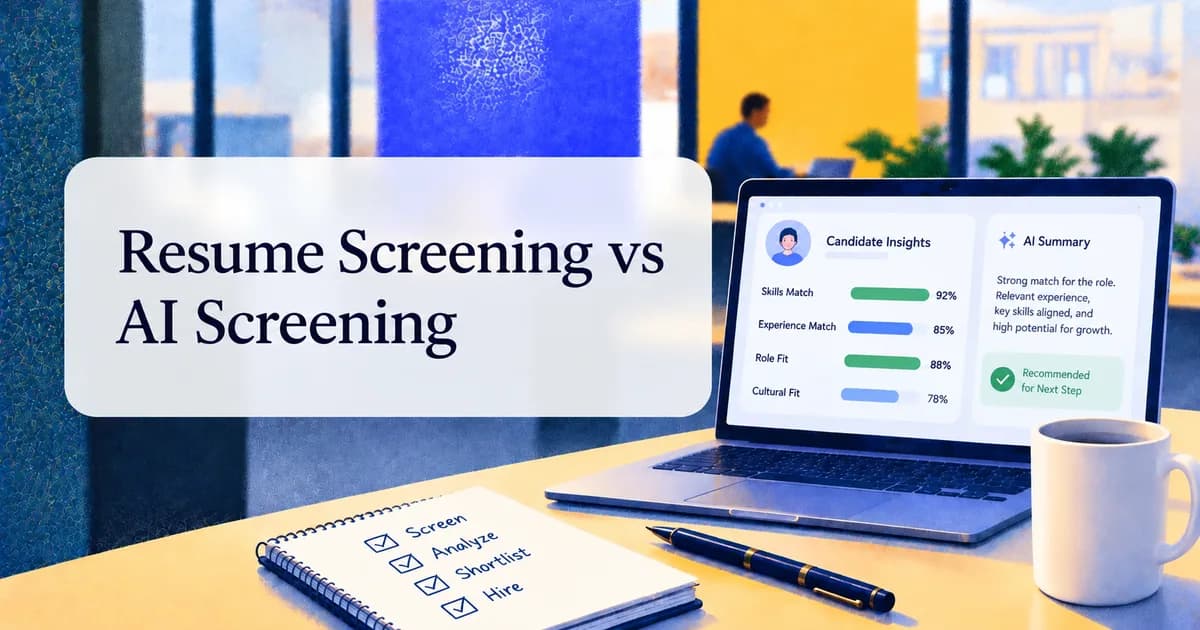
Candidate Screening
Resume Screening vs AI Screening: What Modern Recruiters Should Know
Manual resume review breaks down as application volume grows, but AI screening only helps when recruiters stay in control. Learn how resume screening and AI candidate screening differ, where each works best, and what to look for in AI screening software.
Industry Insights & Trends
The Future of AI in Recruiting: Insights From HR Experts
26 HR leaders, TA directors, staffing founders, and CEOs share how AI will reshape recruiting over the next two to three years, from candidate screening to final hiring decisions.
Candidate Sourcing
LinkedIn Recruiter Alternative: Why TA Teams Are Shifting to AI Agents
LinkedIn Recruiter helped recruiters search faster, but it still leaves the work of reviewing, prioritizing, and following up to them. AI recruiting agents take on more of that workflow, helping TA teams source and engage candidates at scale without growing headcount.