Candidate Interview
September 25, 2026
Pre-Screening Interviews Are Broken. Here's What AI Does Differently.
Traditional pre-screening interviews no longer scale with modern hiring volume. See why structured AI interviews create better candidate experiences and faster, more consistent qualification.
The first interview in most hiring processes is rarely an interview. It's a verification exercise.
The recruiter asks whether the candidate is open to opportunities. They confirm location preferences, compensation expectations, notice period, work authorization, and a handful of questions about experience. The candidate asks about team size, remote work policies, and what happens next.
Twenty minutes later, both sides leave with roughly the same information they had before the conversation started.
The recruiter still needs to brief the hiring manager. The hiring manager still needs to decide whether the candidate progresses. The candidate still waits several days for an update.
And the recruiter moves on to the next call. Then the next. Then the next.
Individually, these conversations don't feel expensive. Collectively, they consume thousands of recruiter hours every year.
The uncomfortable truth is that the traditional pre-screening interview was designed for a recruiting world that no longer exists.
Applications have increased. Candidate expectations have changed. Hiring teams are leaner. Recruiters manage more open roles than ever before.
Yet the first stage of hiring still operates largely the same way it did fifteen years ago.
That's why AI interviews are growing so quickly. Not because companies want fewer conversations, because companies want better conversations.
The Original Purpose of Pre-Screening Interviews
Pre-screening interviews emerged for good reasons.
Recruiters needed a quick way to determine whether candidates met basic hiring criteria before involving hiring managers or technical interviewers. The objective wasn't deep evaluation. It was qualification.
• Does the candidate have the right experience?
• Are compensation expectations aligned?
• Can they legally work in the required location?
• Are they genuinely interested in the opportunity?
For years, this process worked reasonably well because application volumes were manageable and recruiter bandwidth was relatively aligned with hiring demand.
The economics of hiring have changed dramatically since then.
Today, recruiters may review hundreds of applications for a single role while simultaneously managing sourcing, hiring manager communication, interview coordination, employer branding initiatives, and recruiting operations work.
Something had to give. Unfortunately, what often gave way was candidate experience.
Why Traditional Pre-Screening Interviews No Longer Scale
The problem isn't that recruiter phone screens are inherently bad. The problem is that they don't scale with modern hiring complexity.
A recruiter responsible for fifteen open roles may conduct dozens of qualification conversations every week. Many of those conversations cover nearly identical topics.
• Availability.
• Compensation.
• Location preferences.
• Years of experience.
• Relevant technologies.
• Motivation for moving.
The recruiter repeats the same questions. Candidates repeat the same answers.
Everyone invests time. Very little value is created.
This inefficiency becomes particularly visible in high-volume hiring, startup recruiting, operational hiring, and early talent recruiting where candidate volumes can become overwhelming very quickly.
Recruiters don't burn out because they dislike hiring. They burn out because they spend too much time doing repetitive work that doesn't require recruiter expertise.
The Candidate Experience Problem Nobody Talks About
Recruiting teams often assume candidates prefer traditional phone screens because they involve another human being.
Candidates frequently disagree. From the candidate's perspective, pre-screening interviews often introduce friction rather than value.
Candidates wait several days to find interview availability. They join a call that asks questions already answered on their resume. They wait another week for internal feedback.
Eventually they progress to the "real" interview where many of the same questions are asked again.
The experience feels repetitive because it is repetitive. Candidates don't necessarily want more conversations. They want meaningful conversations. The distinction matters.
A twenty-minute scheduling exercise disguised as an interview rarely improves candidate experience simply because another person was involved.
Hiring Delays Compound Faster Than Most Companies Realize
Every additional day in the hiring process creates risk. Strong candidates continue interviewing elsewhere, competing offers emerge, and the enthusiasm that existed at the beginning of the process slowly fades away.
Communication becomes less frequent, momentum disappears, and what initially felt like a strong opportunity starts feeling uncertain from the candidate's perspective.
Many organizations underestimate how quickly these seemingly minor delays accumulate. Two days to schedule a recruiter screen, three days waiting for feedback, four days coordinating hiring manager availability, and another week waiting for scorecards or internal alignment can quickly turn a process that should have taken ten days into one that stretches across five weeks.
Candidates don't experience those delays as individual events. They experience them as one slow hiring process. This is one reason candidate experience and time-to-hire are becoming increasingly connected metrics.
Faster hiring often creates better candidate experiences, not because candidates want rushed decisions, but because they value responsiveness, progress, and momentum.
The companies that consistently win top talent are often not the companies with the biggest brands or the largest recruiting teams. They're the companies that remove friction, maintain momentum, and make candidates feel like the process is moving forward.
AI Interviews Solve a Different Problem Than Most People Think
The conversation around AI interviews often starts in the wrong place. The first question people ask is usually, "Can AI replace interviews?"
But that's not the most interesting question, nor is it the question that recruiting teams should be asking.
A more useful question is: "Which parts of interviewing actually require human involvement?" Few recruiting leaders would argue that compensation discussions should be automated.
Few would remove hiring manager conversations, final interviews, or the relationship-building moments that influence candidate decisions and offer acceptance.
However, qualification conversations, availability checks, location verification, notice periods, and basic role alignment create enormous operational overhead while contributing relatively little strategic value.
Recruiters spend significant amounts of time collecting information rather than evaluating it, which limits the amount of time they can spend on higher-value activities.
AI interviews are designed to solve this problem. They are not replacing human judgment; they are removing repetitive administrative work that prevents recruiters from applying human judgment where it creates the most value.
The objective isn't fewer recruiter conversations. It's better recruiter conversations, less time verifying information and more time assessing potential, building relationships, and influencing hiring outcomes.
What an AI Interview Actually Does
An AI interview is not simply a chatbot asking generic questions. Modern AI interview platforms are increasingly designed to conduct structured qualification conversations while generating useful hiring insights for recruiters and hiring managers.
Depending on the platform, AI interviews may:
• conduct first-round qualification conversations
• ask role-specific screening questions
• evaluate required experience
• capture candidate responses
• generate transcripts
• summarize interview outcomes
• identify qualification signals
• standardize candidate evaluation
The objective isn't to decide who gets hired. The objective is to help hiring teams understand who deserves deeper evaluation.
That's an important distinction.
Why Structured Interviews Usually Produce Better Outcomes
Traditional recruiter screens vary enormously depending on who conducts them.
One recruiter may focus heavily on years of experience and technical expertise. Another may prioritize communication skills and career motivations. A third may spend most of the conversation evaluating culture fit or team alignment.
None of these approaches are necessarily wrong, and in many cases they reflect valuable recruiter instincts developed over years of hiring experience.
The problem is inconsistency. Candidates applying for the same role can experience completely different qualification processes depending on who happens to conduct the interview. One candidate may spend twenty minutes discussing technical depth, while another spends the same amount of time discussing career aspirations and working preferences.
As a result, hiring managers often receive different types of information for different candidates, making objective comparisons significantly more difficult.
This inconsistency creates hidden problems throughout the hiring process. Strong candidates can be overlooked because the right questions were never asked. Weak candidates can progress because qualification standards vary between recruiters.
Hiring managers spend additional time trying to normalize feedback across interviews that were never designed to be comparable in the first place.
Structured interviews solve this problem by introducing consistency without removing flexibility. Every candidate receives the same core qualification questions aligned to the requirements of the role. Every response is captured using the same framework. Every hiring manager receives comparable information that makes candidate evaluation faster and more objective.
AI interviews make this level of consistency scalable. They ensure that every candidate is evaluated against the same qualification criteria regardless of application volume, recruiter workload, or hiring location.
The objective isn't to make interviews robotic. The objective is to create a fair and repeatable foundation that allows recruiters and hiring managers to apply human judgment more effectively.
Consistency improves hiring quality because decisions become easier to compare, patterns become easier to identify, and hiring teams can spend less time interpreting interview notes and more time evaluating candidate potential.
AI Interviews Are Surprisingly Good for Candidate Experience
This may be the most misunderstood aspect of AI interviewing. Many recruiting teams assume candidates will resist AI interviews because they feel impersonal. In reality, candidates often dislike waiting more than they dislike automation.
Candidates value:
• flexibility
• speed
• transparency
• predictability
• progress
AI interviews often improve all five. Candidates can interview when convenient rather than waiting for recruiter calendars. They receive clarity around expectations and can progress through the process more quickly.
For many candidates, that feels more respectful than waiting twelve days for a qualification call that covers information already available elsewhere.
Where AI Interviews Create the Most Value
AI interviews can create value almost anywhere, but some environments benefit more than others.
High-Volume Hiring
Organizations engaged in high-volume hiring face enormous qualification workloads. AI interviews help maintain consistency without overwhelming recruiting teams.
Startup Recruiting
Startups rarely have dedicated recruiting operations teams. Founders, hiring managers, and recruiters wear multiple hats. AI interviews help lean teams move quickly without sacrificing structure.
Early Talent Hiring
Graduate hiring and campus recruiting often generate huge application volumes. AI interviews help teams evaluate candidates fairly and consistently.
Global Hiring
Distributed teams frequently struggle with timezone coordination. AI interviews remove many of those logistical challenges.
Technical Recruiting
Engineering managers are expensive interview resources. AI interviews help ensure technical interview time is reserved for candidates with strong qualification signals.
The Real Future of Interviewing Is Hybrid
The debate between human interviews and AI interviews misses the point entirely.
The future isn't human interviews. The future isn't AI interviews.
The future is both.
For decades, recruiting teams have treated every interview as if it required the same level of human involvement. In reality, different stages of the hiring process create value in very different ways.
Some conversations are administrative and repetitive. Others require judgment, persuasion, and relationship building. Treating them the same creates unnecessary friction for recruiters and candidates alike.
AI is exceptionally good at handling structured, repeatable qualification work. Availability checks, notice periods, location preferences, work authorization, compensation expectations, role alignment, and baseline qualification questions can all be collected consistently and efficiently without requiring recruiter calendars to become bottlenecks.
Humans create value elsewhere. Recruiters create value by building trust, understanding candidate motivations, addressing concerns, selling opportunities, and guiding candidates through important career decisions.
Hiring managers create value through deeper assessment, evaluating problem-solving ability, understanding team fit, and determining whether a candidate can succeed in the role long term.
The result is a more intentional division of labor across the hiring process.
AI handles information gathering. Recruiters handle relationship building. Hiring managers handle assessment and decision-making.
Candidates spend less time repeating information already available on their resume and more time discussing the topics that actually influence hiring decisions. Instead of using interviews to collect administrative information, teams can use interviews to explore potential, ambition, collaboration style, and long-term fit.
This model creates better experiences for everyone involved.
Candidates move through the process faster and encounter fewer repetitive conversations. Recruiters spend less time coordinating and qualifying and more time influencing outcomes. Hiring managers receive stronger signal quality while spending less time on candidates who were never aligned with the role in the first place.
The organizations that win hiring over the next decade are unlikely to be the organizations that automate the most.
They'll be the organizations that understand which parts of hiring should remain deeply human and which parts can be intelligently automated.
The future of interviewing isn't automation replacing human interaction. It's automation protecting human interaction by ensuring it happens where it matters most.
How Robin Approaches AI Interviews Differently
Robin, Cooper's AI Interview Agent, was built around a simple belief: The first interview should create momentum, not delays.
Robin conducts structured AI interviews that help teams qualify candidates quickly while maintaining consistency across the hiring process. Candidate responses are captured, organized, and summarized automatically so recruiters and hiring managers can spend less time reviewing notes and more time evaluating potential.
Instead of waiting for recruiter availability or navigating multiple rounds of scheduling, candidates can complete interviews when it suits them. Hiring teams receive structured insights, qualification context, and interview summaries that make next steps easier and faster.
The result isn't simply reduced time-to-hire. It's a hiring process that feels more responsive, more organized, and ultimately more respectful of candidate time.
And in modern recruiting, that may be one of the strongest competitive advantages a company can build.
FAQs
1. What is an AI interview?
An AI interview is a structured interview conducted or supported by artificial intelligence technology to help organizations qualify, assess, and organize candidate information more efficiently. Depending on the platform, AI interviews can ask role-specific questions, capture candidate responses, generate transcripts, summarize conversations, and provide recruiters with structured insights while keeping final hiring decisions with humans.
2. How are AI interviews different from traditional pre-screening interviews?
Traditional pre-screening interviews are typically conducted manually by recruiters and often focus on repetitive qualification questions such as availability, compensation expectations, location preferences, and relevant experience. AI interviews automate much of this process, allowing candidates to complete interviews faster while providing recruiters with consistent qualification data and reducing scheduling delays.
3. Do AI interviews improve candidate experience?
When implemented correctly, AI interviews can significantly improve candidate experience by reducing waiting times, eliminating scheduling friction, and allowing candidates to interview at a time that works best for them. Candidates generally value speed, transparency, and momentum in hiring processes, and AI interviews can help deliver all three without removing human interaction from later stages of hiring.
4. Can AI interviews replace recruiters or hiring managers?
No. AI interviews are designed to support recruiters and hiring managers rather than replace them. AI handles repetitive qualification conversations and administrative tasks, while recruiters continue to build relationships, assess candidate potential, collaborate with hiring managers, and make final hiring decisions.
5. What should companies look for in AI interview software?
The best AI interview software should provide structured interview workflows, customizable qualification questions, interview transcripts, automated summaries, ATS integrations, recruiter oversight, and a candidate-friendly experience. Organizations should prioritize platforms that improve hiring speed and consistency while maintaining transparency and human decision-making throughout the process.
Read more

Candidate Sourcing
The True Cost of an Empty Candidate Pipeline: How Open Roles Kill Startup Momentum
An empty candidate pipeline is one of the most expensive problems in startup hiring. See the hidden costs of reactive recruiting and how to build a proactive pipeline before roles become urgent.
Volume Hiring
High-Volume Hiring in 2026: Processes, Automation & the Modern Hiring Stack
High-volume hiring in 2026 is an operational challenge, not just a recruiting one. See the modern hiring process, the technology stack behind it, and the mistakes to avoid when scaling recruitment.
candidate screening
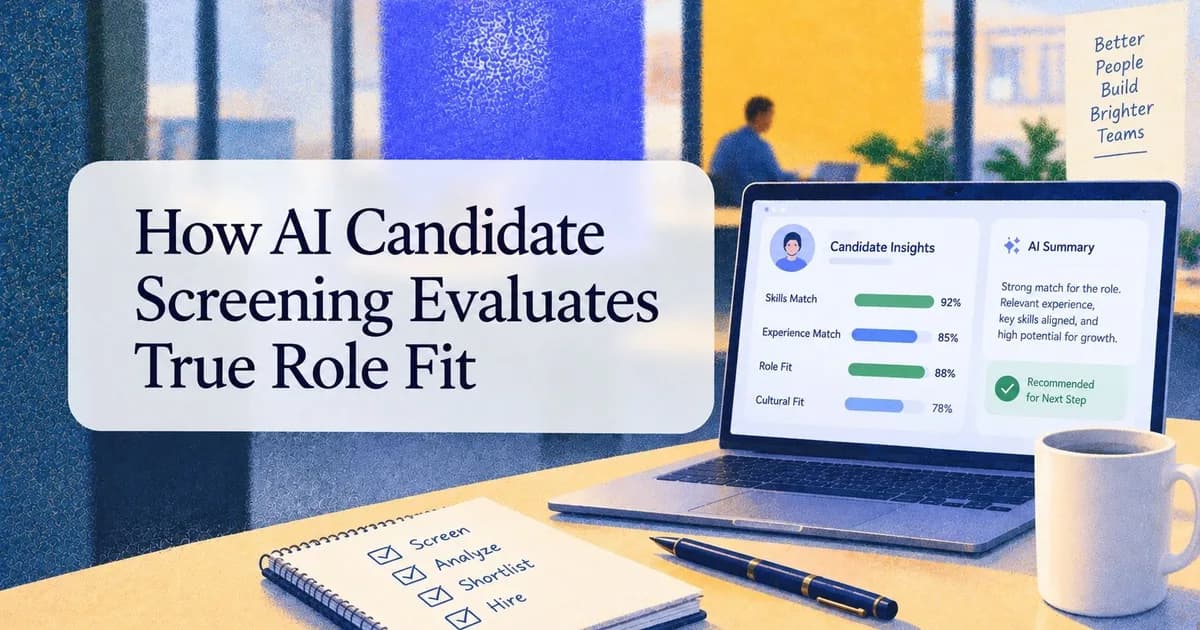
Beyond the Keyword: How AI Candidate Screening Evaluates True Role Fit in 2026
AI candidate screening is moving beyond keyword matching to evaluate true role fit, helping recruiters qualify candidates faster and more consistently. See how it works and how Scout brings this to Cooper's hiring workflow.