Candidate Sourcing
August 19, 2026
AI Candidate Sourcing Explained: How Modern Teams Hire Faster
What AI candidate sourcing actually means, how it works, why companies are adopting it, and how modern hiring teams turn sourcing into a competitive advantage.
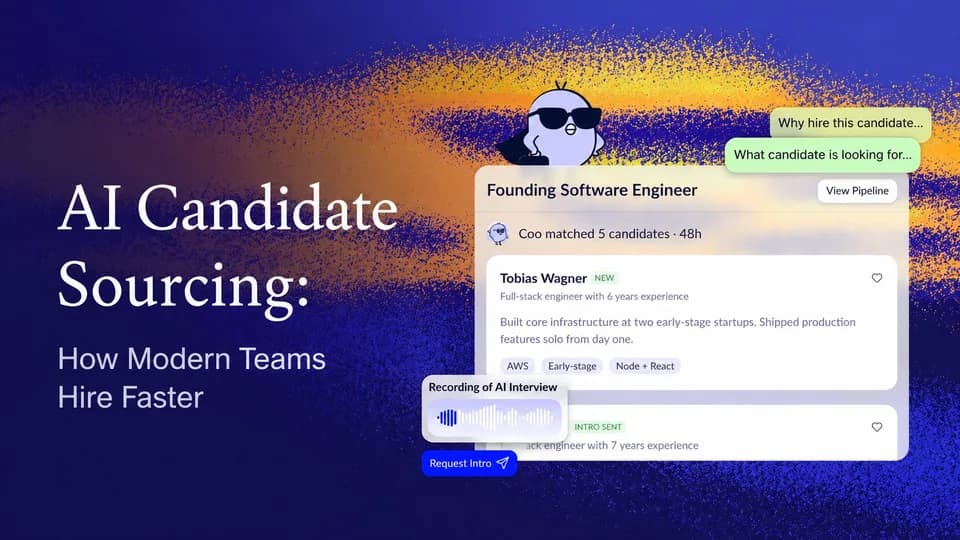
There’s a moment almost every recruiting leader experiences. A role opens. The hiring manager says it’s urgent. Recruiters post the job, open LinkedIn, search databases, scan resumes, send outreach, and wait.
Days pass.
Then weeks.
Applications come in, but not the right ones.
Meanwhile, the strongest candidates already accepted interviews somewhere else. At some point, the problem becomes impossible to ignore: Hiring isn’t slowing down because teams don’t know how to recruit. It’s slowing down because traditional sourcing methods were never designed for today’s hiring environment.
This is exactly why AI candidate sourcing has become one of the fastest-growing shifts in modern recruiting. Companies are realizing that waiting for applicants is no longer a hiring strategy.
The teams hiring fastest in 2026 are sourcing continuously, qualifying earlier, and using AI to identify the right candidates before competitors even enter the conversation.
This guide explains what AI candidate sourcing actually means, how it works, why companies are adopting it, and how modern hiring teams are turning sourcing into a competitive advantage.
What Is AI Candidate Sourcing?
AI candidate sourcing is the process of using artificial intelligence to automatically discover, evaluate, prioritize, and surface candidates for open roles.
Unlike traditional sourcing, which depends heavily on manual searches and recruiter effort, AI sourcing software continuously identifies candidates across available talent channels and recommends who recruiters should engage.
Instead of recruiters asking:
“Where should I search?” The system starts answering:
“Here are the candidates most likely to fit.” Modern AI candidate sourcing tools typically combine:
- candidate discovery
- profile enrichment
- candidate matching
- sourcing automation
- qualification signals
- outreach prioritization
- recruiting workflow automation
The result isn’t simply more candidates. It’s more relevant candidates.
That distinction matters.
Because hiring delays rarely happen due to a lack of applicants. They happen because teams spend too much time finding qualified people.
Why Candidate Sourcing Became the Biggest Hiring Bottleneck
For years, recruiting teams optimized screening. Then interview processes. Then employer branding.
But sourcing quietly became the most expensive part of recruiting.
Why?
Because sourcing doesn’t scale naturally. Every additional role requires additional searching. Every recruiter builds sourcing workflows differently. Every hiring manager defines “good candidate” differently.
This creates inconsistent outcomes.
One recruiter fills roles quickly. Another struggle for weeks. The process becomes dependent on individual effort instead of system performance.
At the same time, candidate behavior changed. Candidates apply broadly. Respond selectively. And increasingly expect proactive engagement.
The old sourcing model: post and wait, started breaking.
AI candidate sourcing emerged because companies needed a way to create predictable candidate pipelines without continuously increasing recruiter headcount.
How AI Candidate Sourcing Actually Works
Many people imagine AI sourcing as simply searching databases faster. Modern systems do much more. Think of AI candidate sourcing as a sequence of connected decisions.
Step 1: Understand Hiring Requirements
Everything starts with understanding what success looks like. Modern AI sourcing platforms analyze:
- role requirements
- experience expectations
- required skills
- qualification criteria
- hiring patterns
- previous successful hires
Instead of relying solely on keyword matching, the system creates a broader understanding of candidate fit.
This becomes especially valuable for roles where experience doesn’t follow a predictable path.
Step 2: Search Across Multiple Talent Sources
Traditional sourcing usually happens in one place at a time. Modern candidate sourcing software expands discovery. AI sourcing engines can evaluate candidates across:
- internal talent databases
- existing ATS records
- professional networks
- sourcing channels
- public professional information
- historical applicant pools
The goal isn’t collecting more profiles. It’s reducing sourcing blind spots. Many companies discover strong candidates already exist inside their own systems. They simply never surfaced.
Step 3: Match and Prioritize Candidates
This is where AI changes recruiter workflows. Instead of creating long candidate lists, the system creates ranked recommendations.
AI candidate sourcing evaluates:
- skill relevance
- role alignment
- experience quality
- qualification indicators
- hiring preferences
- engagement likelihood
Recruiters stop spending hours filtering. They start making decisions faster.
Step 4: Improve Candidate Engagement
Sourcing doesn’t end when candidates are found. Modern sourcing platforms increasingly support recruiter workflows by helping prioritize outreach.
This reduces the classic sourcing problem: Finding candidates but never engaging them effectively. The strongest sourcing systems help teams move candidates from discovery to conversation faster.
Traditional Candidate Sourcing vs AI Candidate Sourcing
The easiest way to understand the shift is to compare operating models. Traditional sourcing was designed for a world where recruiters had lower hiring volume, fewer sourcing channels, and more time to manually evaluate candidates.
That world no longer exists.
Today, recruiters are expected to build stronger pipelines, move faster, and deliver better candidate quality without proportionally increasing team size. That’s where AI candidate sourcing changes the operating model.
Traditional sourcing looks like this:
Recruiter opens search tools → reviews profiles → shortlists → contacts candidates → repeats
AI candidate sourcing looks like this:
Role opens → AI identifies candidates → prioritizes fit → surfaces recommendations → recruiter engages The difference isn’t that recruiters become less important.
The difference is that recruiters stop acting like search engines and start acting like hiring strategists.
Category | Traditional Candidate Sourcing | AI Candidate Sourcing |
Starting Point | Recruiter manually begins search | AI automatically initiates candidate discovery |
Candidate Discovery | Limited to recruiter bandwidth | Continuous and scalable across talent sources |
Search Process | Keyword and filter dependent | Contextual matching and qualification-driven |
Candidate Volume | Smaller pools reviewed manually | Large candidate sets analyzed automatically |
Candidate Quality | Highly dependent on recruiter effort | Prioritized based on fit signals and requirements |
Passive Candidate Access | Mostly manual outreach | Continuous passive candidate identification |
Speed to Shortlist | Days or weeks | Hours to days |
Recruiter Time Allocation | Searching and filtering | Evaluating and engaging |
Workflow Efficiency | Multiple disconnected steps | Connected sourcing workflow |
Scalability | Requires more recruiter capacity | Scales without equivalent headcount growth |
Candidate Experience | Often delayed communication | Faster engagement cycles |
Decision Making | Human-only prioritization | AI-assisted recommendations with recruiter control |
The Biggest Benefits of AI Candidate Sourcing
Companies don’t adopt AI candidate sourcing because it feels innovative. They adopt it because sourcing outcomes improve.
Here are the biggest advantages.
Faster Time to Shortlist
Traditional sourcing often requires recruiters to manually search profiles, review qualifications, and prioritize outreach lists.
That process creates delays, especially when teams are hiring across multiple roles simultaneously.
AI candidate sourcing accelerates candidate discovery by continuously scanning talent pools, evaluating fit signals, and surfacing prioritized candidate lists automatically.
This allows teams to:
- Reduce sourcing cycles
- Move candidates into interviews faster
- Respond before competitors engage top talent
The result is shorter hiring timelines and faster pipeline creation.
Access to Passive Candidates
The strongest candidates often aren’t actively applying for jobs. They may already be employed, evaluating opportunities quietly, or waiting for the right outreach.
AI sourcing software expands talent access by continuously identifying and prioritizing passive candidates based on skills, experience, and hiring requirements.
This enables recruiting teams to:
- Reach candidates earlier
- Expand beyond inbound applicants
- Build healthier talent pipelines
- Reduce dependency on job boards
Instead of waiting for applications, teams create demand proactively.
Better Recruiter Productivity
Recruiters create the most value through conversations and decisions, not searching databases.
AI reduces the administrative burden of sourcing so recruiters spend less time gathering candidates and more time moving hiring forward.
Recruiters shift their focus toward:
- Building candidate relationships
- Running better qualification conversations
- Aligning with hiring managers
- Influencing hiring decisions
- Closing top candidates
The outcome isn’t replacing recruiters - it’s increasing recruiter capacity.
Higher Candidate Quality
Manual sourcing often depends heavily on recruiter experience, search expertise, and available time.
Candidate sourcing software introduces more consistency by evaluating candidates against structured qualification signals rather than intuition alone.
Modern AI sourcing platforms can consider:
- Skills alignment
- Experience relevance
- Role fit indicators
- Hiring criteria consistency
- Historical hiring patterns
This helps teams create stronger shortlists and improve hiring quality over time.
Reduced Agency Dependence
External agencies can accelerate sourcing but often increase costs and reduce visibility into candidate pipelines.
AI candidate sourcing gives internal recruiting teams greater reach and execution capability. With stronger internal sourcing operations, companies can:
- Reduce agency spending
- Build long-term talent pipelines
- Improve recruiter ownership
- Increase hiring efficiency over time
The result is a more scalable and cost-efficient recruiting model.
Use Cases Where AI Candidate Sourcing Creates the Biggest Impact
AI sourcing creates value across many recruiting environments, but the highest impact typically appears where speed, scale, and consistency matter most.
Fast-Growing Teams
Rapidly growing companies experience hiring demand that often outpaces recruiting capacity.
AI candidate sourcing creates scalable sourcing infrastructure that helps teams maintain pipeline quality without increasing recruiter headcount at the same pace.
Key outcomes:
- Faster pipeline generation
- More predictable sourcing capacity
- Reduced operational bottlenecks
High-Volume Hiring
When companies hire across multiple roles simultaneously, manual sourcing quickly becomes difficult to sustain. AI helps prioritize candidate pools automatically and identify the strongest opportunities faster.
This improves:
- Candidate throughput
- Recruiter efficiency
- Hiring speed
Startup Recruiting
Startups often operate with lean recruiting teams and limited budgets. AI sourcing platforms allow smaller organizations to access sourcing capabilities traditionally available only to larger recruiting functions.
Benefits include:
- Faster hiring execution
- Lower dependency on agencies
- Better talent discovery with fewer resources
Technical Hiring
Specialized roles often require recruiters to search across fragmented talent markets. AI sourcing software helps identify candidates based on technical signals, experience patterns, and role fit criteria.
This makes niche hiring more scalable and improves candidate discovery quality.
Candidate Rediscovery
Many organizations already have valuable candidates sitting inside their ATS but rarely reactivate them.
AI sourcing tools can analyze historical candidate databases and surface relevant matches automatically.
Benefits include:
- Reduced sourcing effort
- Faster hiring cycles
- Better use of existing talent assets
Internal Mobility
Hiring externally isn’t always the fastest or best option. AI sourcing systems can identify qualified internal candidates and surface employees who match open roles.
This helps companies:
- Improve retention
- Reduce hiring costs
- Increase employee growth opportunities
How to Evaluate AI Candidate Sourcing Software
Not every sourcing platform delivers meaningful business outcomes. Use this framework to evaluate whether a platform improves hiring performance, not just sourcing activity.
Candidate Quality Over Quantity
More profiles do not automatically create better hiring outcomes. Strong sourcing platforms prioritize precision, not volume.
Measure:
- Candidate relevance
- Interview conversion rates
- Hiring manager satisfaction
- Shortlist quality
Source Diversity
Candidate quality depends heavily on where sourcing happens. Avoid platforms that rely on a single channel or limited database. Broader sourcing creates stronger pipelines.
Look for solutions that support:
- Multiple sourcing channels
- Passive candidate discovery
- Existing ATS activation
- Flexible talent coverage
Matching Transparency
Recruiters should understand why recommendations happen. Transparency improves recruiter trust and adoption.
Ask:
- Why was this candidate surfaced?
- What signals influenced ranking?
- Can matching criteria be adjusted?
Workflow Integration
Candidate sourcing should not operate in isolation. Connected workflows create better execution.
The strongest platforms connect sourcing directly with:
- Screening workflows
- Interview processes
- ATS systems
- Communication automation
- Reporting and analytics
Recruiter Adoption
Even the most advanced platform fails if recruiters avoid using it. The best sourcing platform is the one recruiters consistently rely on.
Evaluate:
- Ease of onboarding
- Workflow simplicity
- Time saved per recruiter
- Daily usage patterns
Why Coo Is Built for the Next Generation of Candidate Sourcing
As sourcing becomes more intelligent, recruiting teams need more than another database. They need a system that actively helps them discover and prioritize talent.
That’s where Coo, Cooper’s AI Super Recruiter, fits. Coo is designed to help teams move beyond manual sourcing by identifying and matching candidates across multiple channels and surfacing the strongest-fit talent faster.
Instead of recruiters spending hours searching and filtering, Coo helps shift sourcing from effort-based to intelligence-driven.
For growing teams, high-volume hiring environments, and recruiters trying to build stronger pipelines without increasing manual work, that’s the direction candidate sourcing is moving.
Not more searching. Better finding.
The Future of Candidate Sourcing
For decades, recruiting started after a role opened. That model is disappearing. The future of sourcing is continuous.
Hiring systems will increasingly:
- build candidate pipelines automatically
- surface passive talent
- recommend outreach opportunities
- rediscover internal candidates
- forecast sourcing outcomes
The strongest recruiting teams won’t wait for candidates. They’ll already know who to talk to. Candidate sourcing becomes less about searching. And more about being ready.
FAQs
What is AI candidate sourcing?
AI candidate sourcing is the process of using artificial intelligence to automatically discover, evaluate, prioritize, and recommend candidates for open roles. Unlike traditional sourcing methods that depend heavily on manual searches, AI candidate sourcing helps recruiting teams identify qualified candidates faster by analyzing skills, experience, role fit, and hiring requirements across multiple talent sources.
How does AI candidate sourcing work?
AI candidate sourcing works by combining candidate discovery, data enrichment, candidate matching, and recruiting automation into one workflow. The system analyzes job requirements, searches available talent pools, identifies potential candidates, ranks them based on fit, and surfaces recommendations for recruiters to review and engage.
Instead of recruiters manually searching profiles, AI helps prioritize where recruiter attention should go first.
What is the difference between AI candidate sourcing and traditional candidate sourcing?
Traditional candidate sourcing relies on recruiters manually searching databases, reviewing profiles, and building shortlists. AI candidate sourcing automates discovery and candidate prioritization.
Traditional sourcing focuses on finding candidates.
AI candidate sourcing focuses on helping recruiters find the right candidates faster.
This often leads to shorter hiring cycles, improved recruiter productivity, and better candidate quality.
What are the benefits of using AI candidate sourcing software?
AI candidate sourcing software helps recruiting teams:
- reduce manual sourcing effort
- identify passive candidates
- improve candidate quality
- shorten time to shortlist
- increase recruiter productivity
- reduce agency dependence
- create more scalable hiring processes
For fast-growing teams and high-volume hiring environments, these improvements can significantly increase hiring efficiency.
Can AI candidate sourcing replace recruiters?
No. AI candidate sourcing is designed to support recruiters—not replace them.
AI helps automate repetitive sourcing tasks and surface candidate recommendations, while recruiters continue to own relationship building, qualification decisions, stakeholder alignment, and final hiring outcomes.
The strongest recruiting teams use AI to increase recruiter leverage, not eliminate recruiter involvement.
What should teams look for in AI candidate sourcing software?
When evaluating AI sourcing software, teams should prioritize:
- candidate matching accuracy
- passive candidate discovery
- sourcing automation capabilities
- workflow integrations
- recruiter usability
- sourcing transparency
- reporting and analytics
The best AI candidate sourcing tools don’t simply generate more profiles, they help recruiters reach better hiring decisions faster.
Read more

Volume Hiring
How to Build a High-Volume Hiring Process Without Growing Your Team
High-volume hiring breaks most recruiting processes long before it breaks the team. Learn the five biggest bottlenecks slowing high-volume hiring down and the framework for building a scalable, AI-powered hiring system that grows without adding headcount.

Volume Hiring
How Lean HR Teams Manage High-Volume Sourcing Without Burning Out
Hiring demand can spike overnight, but lean HR teams can't scale headcount as fast. Here's how AI-powered sourcing helps recruiters handle high-volume hiring without burning out.

Candidate Interview
Pre-Screening Interviews Are Broken. Here's What AI Does Differently.
Traditional pre-screening interviews no longer scale with modern hiring volume. See why structured AI interviews create better candidate experiences and faster, more consistent qualification.