Candidate Interview
September 11, 2026
How AI Interview Agents Reduce Time-to-Hire Without Sacrificing Candidate Experience
AI interview agents remove the scheduling and coordination friction that slows hiring down, helping teams cut time-to-hire while giving candidates a faster, more responsive experience.
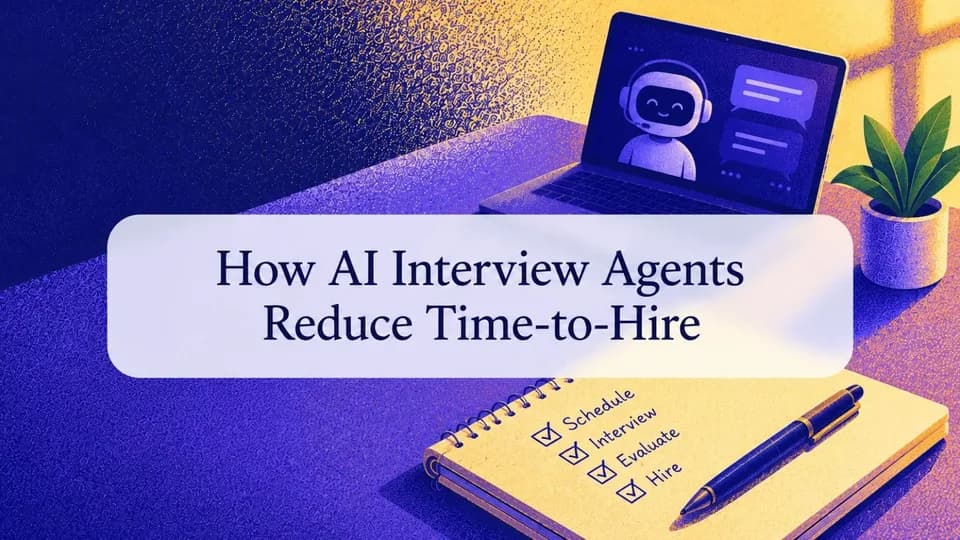
There is a moment in almost every hiring process where momentum quietly disappears.
The recruiter has sourced strong candidates. Hiring managers are excited about the role. Candidates have completed initial conversations and are eager to move forward. On paper, everything looks healthy.
Then reality arrives in the form of calendars.
The hiring manager is traveling next week. One interviewer is fully booked for the next ten days. Another forgets to submit interview feedback. A candidate who was highly engaged three days ago suddenly receives another offer and withdraws from the process.
What should have taken five days turns into three weeks.
Most organizations assume hiring delays are caused by a shortage of candidates. In reality, the biggest bottleneck in modern recruiting is often coordination rather than candidate availability. Scheduling, feedback collection, interviewer availability, and process inefficiencies create more delays than sourcing itself.
This is exactly why AI interview agents have emerged so quickly over the last two years.
The objective isn't replacing interviews or removing human interaction from hiring. The objective is removing operational friction so recruiters and hiring managers can spend more time evaluating talent and less time managing logistics.
That distinction matters because candidate expectations have changed dramatically.
Candidates no longer compare your hiring process against other hiring processes. They compare it against every other digital experience in their lives. They expect responsiveness from employers in the same way they expect responsiveness from banks, e-commerce platforms, and customer support teams.
When communication slows down, candidates notice. When interviews take weeks to schedule, candidates notice.
When feedback disappears into a black hole, candidates notice. The hiring process itself has become part of the employer brand.
Why Interviews Became the Largest Hiring Bottleneck
For years, recruiting teams assumed sourcing was the hardest part of hiring. That was often true when candidate discovery depended heavily on job boards and recruiter networks.
Modern sourcing technology has changed that equation.
Today, the biggest delays often appear after recruiters have already identified qualified candidates. Scheduling first-round interviews, coordinating hiring panels, collecting scorecards, and aligning stakeholders frequently add days or even weeks to the process.
A single interview may involve five or six people behind the scenes.
Someone has to schedule the meeting. Someone has to prepare interview questions. Someone has to collect feedback. Someone has to summarize the discussion and communicate next steps to the candidate.
Multiply that across dozens of candidates and multiple open roles and the operational burden becomes enormous.
Recruiters increasingly find themselves acting as project managers rather than talent advisors. Hiring managers spend more time writing interview notes than evaluating candidates. Candidates spend more time waiting than engaging.
The result is predictable:
• Longer time-to-hire
• Higher candidate drop-off
• Lower offer acceptance rates
• Poorer candidate experience
• Increased recruiter burnout
AI interview agents were built to solve precisely these problems.
What Is an AI Interview Agent?
An AI interview agent is software designed to automate and support parts of the interview process that traditionally consume recruiter and hiring manager time.
Unlike scheduling tools or interview transcription platforms, AI interview agents participate directly in interview workflows. Depending on the platform, they may conduct structured first-round interviews, ask qualification questions, generate summaries, capture transcripts, and organize candidate insights for hiring teams.
The important distinction is that an AI interview agent is not a replacement for recruiters or hiring managers.
Instead, it functions much more like an intelligent recruiting assistant.
It handles repetitive qualification conversations. It ensures consistency across candidate evaluations. It organizes information in a format that helps recruiters make faster and better decisions.
Human judgment remains exactly where it should be: with humans.
Why Candidate Experience Often Breaks During Interviews
When candidates describe poor hiring experiences, they rarely complain about difficult interview questions.
They complain about waiting.
Waiting for interview invitations.
Waiting for feedback.
Waiting for hiring managers to become available.
Waiting for recruiters to return with updates that never seem to arrive.
Uncertainty creates anxiety in ways that rejection rarely does.
Most candidates can accept hearing "no."
What they struggle with is hearing nothing.
Unfortunately, traditional interview processes create long periods of silence because every stage depends on manual coordination between multiple stakeholders.
Candidates interpret those delays as signals. If scheduling an interview takes two weeks, they assume the company moves slowly. If feedback disappears for ten days, they assume internal communication is poor. If interviewers appear unprepared, they assume collaboration inside the business looks similar.
Whether fair or unfair, candidates use hiring experiences as proxies for company culture. Recruiting teams are no longer simply evaluating candidates. Candidates are evaluating recruiting teams too.
The False Trade-Off Between Speed and Candidate Experience
Many recruiting leaders still believe they must choose between moving quickly and delivering a great candidate experience.
The assumption sounds reasonable.
Move too quickly and candidates feel rushed. Move too slowly and candidates feel respected.
The reality is almost the opposite.
The strongest candidate experiences are usually associated with the fastest hiring processes.
Not because decisions happen recklessly. Because momentum creates confidence.
Fast communication signals organization. Fast feedback signals respect.
Fast scheduling signals intent. Candidates do not enjoy waiting simply because companies believe thoughtful hiring requires delays.
They value transparency and progress far more than unnecessary processes.
The companies winning talent in 2026 have learned an important lesson:
Candidate experience isn't about adding more stages. It's about removing unnecessary friction between stages.
How AI Interview Agents Reduce Time-to-Hire
The biggest impact of AI interview agents comes from eliminating the hidden operational work surrounding interviews.
Recruiters spend an extraordinary amount of time scheduling conversations, collecting feedback, documenting outcomes, and coordinating stakeholders. None of these activities directly improve hiring quality, yet they consume a significant percentage of recruiting capacity.
AI interview agents change this equation in several ways.
They reduce dependency on overlapping calendars by allowing candidates to complete structured interviews asynchronously. They automatically generate interview transcripts and summaries, reducing note-taking and administrative work. They standardize qualification questions, improving consistency while making candidate comparisons easier.
Most importantly, they allow recruiters to focus on the work only recruiters can do.
Building relationships. Understanding motivations. Managing stakeholders. Closing candidates.
That is a much better use of recruiter expertise than scheduling meetings.
Why AI Interviews Don't Need to Feel Robotic
The biggest concern organizations have about AI interview agents is usually emotional rather than technical.
Will candidates hate it?
Interestingly, candidates tend to be far more accepting of AI interviews than hiring teams expect.
Most candidates don't object to technology.
They object to wasting time.
When implemented well, AI interviews provide faster scheduling, greater flexibility, and more predictable experiences. Candidates can complete interviews when convenient rather than waiting for recruiter availability or navigating multiple reschedules.
The experience feels less like automation and more like convenience.
In many cases, candidates actually prefer a structured twenty-minute interview completed on their own schedule over waiting twelve days for a recruiter phone screen that covers the same qualification questions.
The future of interviewing isn't human or AI. It's human judgment supported by intelligent systems that remove unnecessary friction from the hiring process.
How Robin Helps Teams Interview Faster
Robin, Cooper's AI Interview Agent, was built around a simple principle: Recruiters should spend their time evaluating candidates, not coordinating calendars.
Robin conducts structured AI interviews, captures candidate responses, generates interview summaries, and organizes qualification insights so hiring teams can move faster with greater confidence.
Candidates benefit from faster progression and more predictable timelines. Recruiters benefit from reduced administrative work and more consistent evaluations. Hiring managers receive better interview context before investing time in later-stage conversations.
The result isn't simply shorter hiring cycles.
It's a hiring experience that feels more responsive, more organized, and ultimately more human because recruiters have more time to focus on people instead of process.
FAQs
1. What is an AI interview agent?
An AI interview agent is software that helps automate and support parts of the interview process, such as conducting first-round interviews, asking qualification questions, generating interview summaries, capturing transcripts, and organizing candidate insights for hiring teams. Unlike traditional interview scheduling tools, AI interview agents actively participate in the interview workflow while keeping recruiters and hiring managers in control of final decisions.
2. How do AI interview agents reduce time-to-hire?
AI interview agents reduce time-to-hire by eliminating scheduling bottlenecks, automating repetitive qualification conversations, generating interview summaries automatically, and helping recruiters prioritize stronger candidates faster. By reducing administrative work and improving interview consistency, organizations can move candidates through the hiring process more efficiently without compromising hiring quality.
3. Do candidates like AI interviews?
Candidate acceptance of AI interviews is significantly higher than many organizations expect. Most candidates value flexibility, faster communication, and shorter hiring timelines more than traditional scheduling processes. When implemented correctly, AI interviews can improve candidate experience by allowing candidates to interview on their own schedule while reducing delays and uncertainty.
4. Can AI interview agents replace recruiters or hiring managers?
No. AI interview agents are designed to support recruiters and hiring managers rather than replace them. They automate repetitive operational tasks such as screening conversations, note-taking, and interview documentation, allowing recruiters to spend more time building relationships, evaluating candidates, and making hiring decisions.
5. What should companies look for in an AI interview agent?
The best AI interview agents offer structured interview workflows, customizable interview questions, interview transcripts, automated summaries, ATS integrations, candidate-friendly experiences, and transparent evaluation criteria. Organizations should prioritize platforms that improve recruiter productivity and candidate experience while maintaining human oversight throughout the hiring process.
Read more
AI Recruiting
What is an AI Recruiting Agent? Everything Recruiters Need to Know
An AI recruiting agent executes connected hiring tasks toward a goal. Learn how it works, how it differs from AI assistants, and what to evaluate before adopting one.
AI Recruiting
Skills-Based Hiring: Why Companies are Moving Beyond Degrees and Job Titles
Skills-based hiring evaluates what candidates can do, not where they studied or what their last title was. Learn why companies are making the shift and how AI helps.
Volume Hiring
Blue-Collar Hiring in 2026: How to Recruit, Screen & Hire Frontline Workers Faster
Blue-collar hiring is a process design problem, not a volume problem. Learn how to recruit, screen and hire frontline workers faster in 2026.