AI Recruiting
October 12, 2026
Startup Guide to Campus Recruiting Automation: Hire Top Talent Without Campus Visits
Startups do not need to visit dozens of campuses to hire early-career talent. Learn how virtual campus hiring, AI screening and automated interviews help lean teams run a scalable campus recruiting process, from outreach and assessments to offers and joining.
For many startups, campus hiring feels like a privilege reserved for large companies. Big employers visit prestigious colleges, sponsor placement events, bring large recruiting teams, and make offers at a scale that smaller businesses cannot easily match. Startups often assume they need the same physical presence, brand recognition, and recruitment budget to compete for early-career talent.
That assumption is becoming outdated.
A startup does not necessarily need to visit dozens of campuses to build a strong graduate talent pipeline. With the right combination of virtual campus hiring, structured assessments, AI screening, automated interviews, and candidate engagement, a lean team can reach students across multiple colleges without spending weeks travelling from one campus to another.
The opportunity is not simply to move campus recruitment online. It is to redesign the entire process around speed, consistency, and candidate experience.
This is where campus recruiting automation becomes valuable. Instead of relying on spreadsheets, emails, manual shortlisting, and disconnected interview coordination, startups can build a repeatable hiring system that handles high-volume work while keeping important human interactions intact.
The result is a more scalable way to hire top talent without campus visits.
Why Traditional Campus Hiring is Difficult for Startups
Traditional campus recruitment is operationally demanding. A company must identify relevant colleges, contact placement officers, negotiate drive dates, arrange travel, prepare presentations, coordinate assessments, manage interview panels, communicate with students, and track offers after the event.
For a large enterprise, these activities may be distributed across a dedicated campus hiring team. For a startup, the same work may fall on one recruiter, an HR generalist, or even a founder.
That creates a serious capacity problem. The startup may have a compelling role, strong learning opportunities, and an environment where graduates can take on meaningful responsibility. But if the recruiting process is slow or difficult to coordinate, those advantages may never reach the right candidates.
There is also a timing issue. Campus hiring often happens in concentrated bursts. A startup may suddenly need ten software engineers, twenty sales trainees, or a cohort of customer support associates. The hiring requirement is immediate, but building relationships with multiple campuses can take weeks or months.
Physical campus visits add another layer of cost and complexity. Travel, accommodation, event participation, printed materials, and employee time can quickly make a campus drive expensive before a single candidate has been interviewed.
Virtual campus hiring changes the equation. It allows startups to connect with colleges and students across different regions without being physically present at every location. Online assessments, digital registration, remote interviews, and automated communication can make the process accessible to a much wider talent pool.
The important point is that virtual hiring should not be treated as a cheaper version of an offline event. It should be designed as a better operating system for early-career recruitment.
Campus Recruiting Automation is More Than Online Interviews
Many companies use the term campus recruiting automation to describe an online application form or a video interview link. Those tools are useful, but they represent only a small part of the opportunity.
True campus recruitment automation connects the stages of the hiring process so that candidates move forward without recruiters manually coordinating every step.
A typical automated campus hiring workflow starts with college outreach and candidate registration, followed by eligibility checks, assessments, AI screening, and structured interviews. Recruiters then review shortlisted candidates, manage offers, and keep students engaged throughout the pre-joining process.
Each stage produces information that should flow into the next stage. A candidate who passes an assessment should not need to be manually copied into another spreadsheet. A candidate who completes an interview should not have to wait several days for someone to update their status. A recruiter should be able to see how many candidates are progressing, where bottlenecks are developing, and which students need attention.
This connected approach matters because campus hiring is a burst workload. A startup may receive hundreds or thousands of applications within a short period. The process must handle that volume without forcing the recruiting team to grow at the same rate. That is the same challenge behind high-volume hiring in any other setting.
The goal is not to automate every human interaction. The goal is to automate repetitive coordination so recruiters can focus on decisions, communication, and relationship building.
Start With a Clear Campus Hiring Strategy
Automation cannot rescue an unclear hiring plan. Before selecting software or contacting colleges, startups should define exactly what they want to hire and what success will look like. This includes the number of hires, target joining date, role requirements, salary range, location, work model, and expected career path.
A startup should also distinguish between essential and preferred qualifications. For example, a graduate software engineer role may require strong problem-solving ability, basic programming knowledge, and the ability to learn quickly. A specific degree, college brand, or exact technology stack may be preferred but not essential.
This distinction has a direct impact on screening quality. If every preference is treated as a strict filter, the startup may eliminate talented candidates who do not fit a narrow profile. If the requirements are too broad, the recruiting team may receive a large number of applications that are difficult to evaluate.
A practical campus hiring brief should answer five questions:
1. What business problem will this hire solve?
2. Which skills are genuinely essential from day one?
3. Which capabilities can be developed after joining?
4. What behaviours indicate potential in an early-career candidate?
5. What should the selection process measure?
Once these questions are clear, automation can be configured around meaningful criteria rather than superficial keywords.
Build a Virtual Campus Hiring Funnel
A virtual campus hiring funnel allows startups to engage candidates without requiring them to attend a physical event. The funnel should be simple enough for students to understand and structured enough for recruiters to manage at scale.
The first stage is digital outreach. Startups can work with placement cells, student communities, college clubs, coding societies, business clubs, and online career networks. A startup does not need to limit itself to a small group of well-known institutions. Regional colleges and emerging universities may offer access to capable candidates who receive less attention from large employers. For this kind of outreach at scale, Coo, Cooper's AI Super Recruiter can help find and engage the right student profiles.
The message should explain why the opportunity is worth considering. Students want to know what they will work on, what they can learn, who they will work with, and how the role could shape their career. A generic job description is rarely enough.
After outreach, candidates should be directed to a clear registration process. The form should collect only information that is relevant to eligibility and evaluation. Long forms create friction, especially when students are applying from mobile devices.
The next stage is automated eligibility checking. Criteria such as graduation year, degree, location, work authorization, or required academic qualifications can often be checked automatically. However, exceptions should be routed to a human reviewer rather than rejected without explanation. This creates a faster process without turning the system into a rigid filter. Mapping each of these steps is easier when you understand your hiring funnel end to end.
Use AI Screening to Handle Application Volume
Application volume is often the first major bottleneck in campus hiring. A startup may attract hundreds of students for a single role, but its recruiting team may have only a few hours to review applications. Manual resume screening becomes inconsistent under this pressure. Recruiters may rely on college names, familiar keywords, or quick visual impressions simply because they do not have enough time to examine every profile carefully.
AI screening can provide a more structured first layer of evaluation. An effective AI screening system, such as Scout, Cooper's AI Screening Agent, should assess candidates against the actual hiring criteria. It should identify relevant skills, academic projects, internships, practical experience, certifications, communication indicators, and other role-specific signals.
For early-career hiring, the system should also be able to recognize potential. A student may not have formal work experience but may have built a meaningful project, contributed to an open-source repository, led a college initiative, or demonstrated strong problem-solving through competitions.
This is why contextual screening is more useful than basic keyword matching.
The objective is not to let AI make the final hiring decision. The objective is to help recruiters process a large candidate pool consistently and identify which profiles deserve deeper review.
Startups should also insist on explainable recommendations. If an AI system prioritizes one candidate over another, recruiters should be able to understand the reasons. The system should show relevant evidence and highlight potential gaps rather than presenting an unexplained score.
Automate First-Round Interviews Without Losing Structure
First-round interviews can consume a significant amount of recruiter and employee time. When a startup is hiring a large graduate cohort, conducting the same introductory conversation hundreds of times can quickly overwhelm the team.
AI interview agents can help by conducting structured first-round conversations at scale.
Depending on the role, an AI interview agent such as Robin may ask candidates about their experience, projects, technical understanding, problem-solving approach, communication, availability, or motivation. It can capture responses, generate transcripts, summarize relevant evidence, and organize results for recruiter review.
This creates two important advantages. First, candidates can complete the initial conversation without waiting for a recruiter's calendar to open. Second, every candidate can be evaluated against a consistent structure rather than receiving a completely different experience depending on which interviewer is available.
However, structure should not be confused with blind automation. Startups should define interview rubrics before launching the process. They should decide which competencies matter, what strong evidence looks like, and which answers require human review. Borderline cases, unusual backgrounds, accessibility needs, and technical edge cases should be routed to people.
The best model is not "AI interviews everyone and chooses the winners." It is "AI handles the repeatable first layer, while recruiters and hiring managers make informed decisions."
Make Scheduling and Candidate Communication Automatic
Scheduling is one of the least strategic but most time-consuming parts of campus recruitment.
When hundreds of students are moving through assessments and interviews, manual coordination creates unnecessary delays. Recruiters may spend hours sending reminders, finding available interviewers, rescheduling missed slots, and answering repetitive questions.
Automation can remove much of this operational burden. A well-designed virtual campus hiring workflow should support automated interview invitations, calendar coordination, reminders, rescheduling, status updates, and candidate notifications. It should also provide a clear candidate dashboard or communication trail so students know what happens next.
This is more than an efficiency improvement. Candidate communication directly affects conversion. Students often have several opportunities available at the same time. If one company communicates clearly and moves quickly while another leaves candidates waiting, the faster and more transparent company may win the candidate.
Automated communication should therefore be timely but not robotic. Candidates should receive clear information about the next step, expected timelines, preparation requirements, and whom to contact if they need help. Automation should make the process feel more organised, not less human.
Keep the Human Touch Where It Matters Most
The strongest campus recruitment strategies do not attempt to automate everything. Some parts of the process are better handled by people because they involve trust, motivation, judgment, or emotional context.
Startups should keep human involvement in areas such as employer storytelling, final interviews, offer conversations, candidate concerns, and pre-joining engagement.
This is especially important for startups competing against larger brands. A student may not know the company name, but they may be persuaded by a conversation with the founder, a future manager, or a recent graduate who can explain what working at the startup is really like. A strong employee value proposition gives those conversations something concrete to build on.
A virtual process can still feel personal when it includes live information sessions, employee panels, manager conversations, and opportunities for candidates to ask questions.
The right principle is simple: Automate scale. Humanise trust.
Registration, assessments, scheduling, reminders, and basic qualification can be systemised. Relationship building, final judgment, and selling the opportunity should remain human.
Design the Offer Process for Speed
Many startups focus heavily on applications and interviews but underestimate what happens after selection.
In campus hiring, the period between selection and joining is critical. Students may receive several offers, change their preferences, accept a higher-paying opportunity, or become uncertain about joining a smaller company.
A slow offer process increases the risk of losing candidates. Automation can help startups generate offer documents, track acceptance status, collect required information, send reminders, and monitor joining forecasts. Recruiters should have a live view of how many candidates have accepted, how many have completed documentation, and where additional engagement is needed.
But offer conversion cannot be solved through automated emails alone. Important candidates may need a personal call from the hiring manager. Students may want to understand training plans, career progression, team structure, or the stability of the business. A founder-led conversation can often communicate confidence and purpose more effectively than a standard message.
The strongest approach combines automated administration with high-touch candidate engagement.
Measure the Metrics That Actually Matter
Campus recruiting automation should be evaluated through outcomes, not the number of features enabled. Startups should track the full funnel, including:
• Applications received
• Eligible candidates
• Assessment completion rate
• Assessment to interview conversion
• Interview completion rate
• Qualified candidate rate
• Time to shortlist
• Time to offer
• Offer acceptance rate
• Offer to joining conversion
• Candidate drop-off rate
• Cost per hire
• Recruiter hours per hire
• Quality of hire after six and twelve months
• Retention of campus hires
These metrics help identify where the process is failing. For a wider list of KPIs, see these recruitment metrics to track.
For example, a high application volume with a low assessment completion rate may indicate poor communication or a difficult registration process. A strong offer acceptance rate with a weak joining rate may point to insufficient pre-joining engagement. A high interview volume with low quality of hire may suggest that screening criteria are not aligned with actual job performance.
The most valuable metric is not necessarily how many students enter the funnel. It is how effectively the startup turns the right candidates into successful employees.
Common Mistakes Startups Should Avoid
The first mistake is treating automation as a replacement for strategy. Software cannot compensate for unclear roles, unrealistic requirements, or weak employer messaging.
The second mistake is automating rejection too aggressively. AI should help identify relevant candidates, but unusual profiles and borderline cases deserve human review.
The third mistake is creating a cold candidate experience. A process can be fully virtual and still be engaging. Candidates should hear from real employees, understand the opportunity, and receive clear updates.
The fourth mistake is focusing only on top-tier colleges. A narrow campus strategy can limit access to capable students and increase competition. Startups should test different institutions, regions, and student communities.
The fifth mistake is ignoring the offer-to-joining stage. Hiring is not complete when an offer is issued. Startups need a plan to maintain engagement until the candidate joins.
A Practical 30-Day Plan for Launching Campus Recruiting Automation
Startups do not need to automate the entire process on day one. During the first week, define the roles, hiring targets, eligibility criteria, interview competencies, and candidate journey. Identify which steps currently consume the most recruiter time.
During the second week, set up the virtual application funnel, registration form, assessment process, and candidate communication templates. Make sure the process works smoothly on mobile devices.
During the third week, introduce AI screening or structured first-round interviews. Test the system with a smaller candidate group and compare AI recommendations with human recruiter judgments. Adjust the criteria before scaling.
During the fourth week, launch the complete virtual campus drive, monitor funnel metrics, and collect feedback from candidates, recruiters, and hiring managers.
This staged approach reduces risk. It also helps the startup learn which parts of the process benefit most from automation.
The Future of Startup Campus Hiring is Distributed and Intelligent
Campus hiring is no longer limited to companies that can physically visit a small number of institutions.
Virtual campus recruitment allows startups to reach candidates across geographies. Automation allows lean teams to manage high application volumes. AI screening and interview agents reduce repetitive evaluation work. Structured workflows improve consistency and visibility.
But technology alone will not create a compelling early-career hiring program.
Startups still need a strong employee value proposition, clear role expectations, credible leadership, fair evaluation, and meaningful candidate communication. The companies that win will combine operational efficiency with a candidate experience that feels thoughtful and authentic.
The future of campus recruiting is not about choosing between technology and human connection. It is about using technology to make human connection possible at greater scale.
For startups, that means the ability to hire top talent without visiting every campus, building a large recruiting department, or relying on manual coordination for every stage of the process.
With the right campus recruiting automation strategy, a small team can build a hiring engine that reaches further, moves faster, and gives candidates a better reason to say yes.
FAQs
What is campus recruiting automation?
Campus recruiting automation is the use of recruitment software and AI to automate repetitive stages of graduate and student hiring. It can include candidate registration, eligibility checks, assessments, AI screening, interview scheduling, automated communication, offer tracking, and pre-joining engagement. The purpose is to help companies manage high-volume campus hiring without increasing recruiter workload at the same rate.
Can startups hire from colleges without visiting campuses?
Yes. Startups can use virtual campus hiring to connect with placement cells, student communities, college clubs, and universities without travelling to every campus. Online applications, digital assessments, remote interviews, and automated communication can support the early stages of hiring. Startups should still include live employee sessions and personal conversations to build trust and communicate the company's value proposition.
How does AI help with campus recruitment?
AI can help recruiters process large application volumes, identify relevant candidate profiles, evaluate responses against defined criteria, conduct structured first-round interviews, generate interview summaries, and prioritize candidates for human review. AI is most effective when it handles repetitive work while recruiters remain responsible for final decisions, exceptions, and relationship building.
What are the best tools for virtual campus hiring?
The best virtual campus hiring tools typically include candidate registration, eligibility filtering, online assessments, AI or structured interviews, scheduling, automated notifications, recruiter dashboards, and offer tracking. Startups should choose a platform based on hiring volume, role complexity, integration needs, data privacy, explainability, and the quality of candidate experience rather than selecting software based only on the number of features. Our guide on how to choose an AI recruiting platform covers the key questions to ask.
How can startups improve campus hiring offer acceptance and joining rates?
Startups can improve offer acceptance and joining rates by communicating quickly, explaining the role clearly, offering transparent information about growth and training, involving hiring managers in important conversations, and maintaining regular pre-joining engagement. Automated reminders and document collection help with administration, but personal calls, mentor interactions, and meaningful updates are often more effective when candidates are considering competing offers.
Read more
Candidate Screening
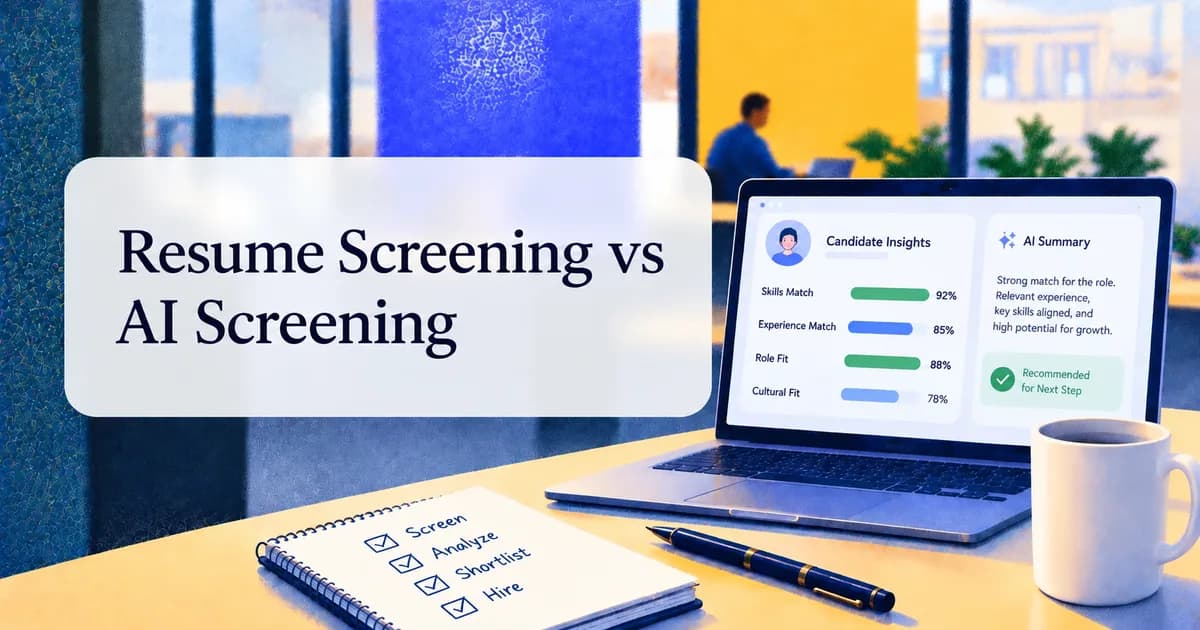
Resume Screening vs AI Screening: What Modern Recruiters Should Know
Manual resume review breaks down as application volume grows, but AI screening only helps when recruiters stay in control. Learn how resume screening and AI candidate screening differ, where each works best, and what to look for in AI screening software.
Industry Insights & Trends
The Future of AI in Recruiting: Insights From HR Experts
26 HR leaders, TA directors, staffing founders, and CEOs share how AI will reshape recruiting over the next two to three years, from candidate screening to final hiring decisions.
Candidate Sourcing
LinkedIn Recruiter Alternative: Why TA Teams Are Shifting to AI Agents
LinkedIn Recruiter helped recruiters search faster, but it still leaves the work of reviewing, prioritizing, and following up to them. AI recruiting agents take on more of that workflow, helping TA teams source and engage candidates at scale without growing headcount.