Candidate Screening
October 9, 2026
Resume Screening vs AI Screening: What Modern Recruiters Should Know
Manual resume review breaks down as application volume grows, but AI screening only helps when recruiters stay in control. Learn how resume screening and AI candidate screening differ, where each works best, and what to look for in AI screening software.
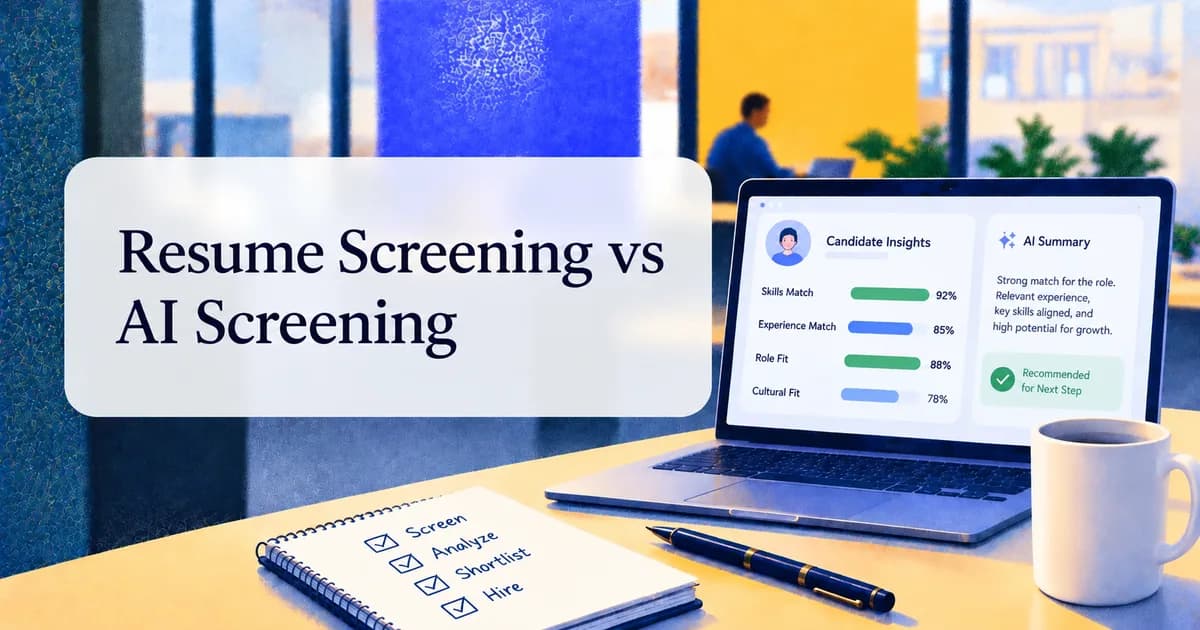
A recruiter opens a new requisition and, within hours, the resumes start arriving. Ten applications become fifty. Fifty becomes two hundred. By the end of the week, there may be hundreds of resumes sitting between an ATS, an inbox, and a hiring manager's shortlist.
The instinct is simple: start screening.
But resume screening has quietly become one of the biggest bottlenecks in modern recruiting. The problem is not that recruiters cannot read resumes. It is that they are being asked to read too many of them, too quickly, while making consistent judgments about skills, experience, qualifications, and potential.
That is where AI screening enters the picture. Traditional resume screening depends heavily on recruiter time and predefined filters. AI candidate screening uses artificial intelligence to analyze candidate information, identify relevant signals, prioritize profiles, and support recruiters in deciding who deserves closer attention.
The difference is not simply about speed. It is about changing how recruiters spend their attention.
For a hiring team receiving 30 applications, manual resume screening may be perfectly manageable. For a company receiving 3,000 applications across multiple roles, the same approach can become a serious operational constraint.
So which approach is better? The answer depends on the role, hiring volume, quality of your hiring criteria, and how much judgment your recruiting process requires. But understanding the difference between resume screening vs AI screening is becoming essential for any modern recruiting team.
What is Traditional Resume Screening?
Traditional resume screening is the process of reviewing candidate resumes and applications to determine whether they meet the requirements of a particular job.
The recruiter typically starts with a job description and creates a mental or documented checklist. They look for relevant job titles, years of experience, qualifications, skills, industry background, location, education, and other requirements.
In many organizations, an ATS provides filters that make this process easier. Recruiters may search for keywords, apply location or experience filters, and sort candidates based on application information.
The final judgment, however, generally remains with the recruiter. That human involvement is one of the strengths of traditional screening. An experienced recruiter can recognize context that a simple filter might miss. They can understand unusual career paths, transferable skills, progression, and nuances within a candidate's experience.
But there is a tradeoff. Manual resume screening takes time, and the more applications a company receives, the harder it becomes to maintain the same level of attention and consistency.
What is AI Candidate Screening?
AI candidate screening uses artificial intelligence to analyze candidate information and help recruiters determine which applicants are most relevant to a role.
Rather than relying entirely on manual resume review, AI screening software can evaluate candidate profiles against job requirements and identify relevant skills, experience, qualifications, and other signals.
Modern AI recruiting platforms can go beyond simple keyword matching. For example, a candidate might not use the exact phrase contained in the job description but may have performed highly relevant work under a different title. AI can potentially recognize relationships between skills, responsibilities, experience, and role requirements that traditional keyword filters may overlook.
The goal is not to make the hiring decision automatically. The goal is to reduce the amount of information recruiters have to process before making that decision.
That distinction matters. AI screening should make human judgment more efficient, not make human judgment irrelevant.
Resume Screening vs AI Screening: The Core Difference
The fundamental difference is how each approach handles candidate information. Traditional resume screening asks the recruiter to process the information.
AI screening helps process the information before it reaches the recruiter's attention.
Area | Traditional Resume Screening | AI Candidate Screening |
|---|---|---|
Resume review | Primarily manual | AI assisted |
Candidate prioritization | Recruiter driven | AI supported |
Matching | Keywords and filters | Context, skills, experience and role fit |
Scale | Limited by recruiter capacity | Designed for larger candidate volumes |
Speed | Can take hours or days | Can reduce initial screening time |
Consistency | Can vary between reviewers | More standardized criteria |
Transferable skills | Depends on recruiter judgment | AI can identify related signals |
Recruiter role | Search, review and evaluate | Review, validate and make decisions |
Best use case | Smaller applicant volumes | High volume and repetitive screening |
Human oversight | Central | Still essential |
Neither method is automatically superior for every situation. The important question is what your hiring process demands.
The Biggest Problem With Manual Resume Screening is Not Accuracy
When recruiters complain about resume screening, the first assumption is usually that the process is inefficient.
It is, but the bigger issue is attention.
Recruiters have a limited amount of cognitive bandwidth. Reviewing the first 20 resumes of the morning may involve careful evaluation. Reviewing resume number 220 is a different experience.
Repetitive work creates fatigue. That can affect consistency, especially when recruiters are managing multiple requisitions simultaneously.
A candidate who would have received careful consideration early in the process may receive a faster rejection later simply because the recruiter is trying to get through an overwhelming queue.
This is one reason high volume recruiting creates a difficult tension between speed and quality. AI screening can help by processing large candidate volumes consistently and presenting recruiters with a prioritized group for review. The recruiter still decides. But the recruiter doesn't have to start with the entire pile.
Where Traditional Resume Screening Still Wins
It would be a mistake to assume AI screening makes manual resume review obsolete. Human recruiters remain better at understanding certain forms of context.
Consider a candidate who spent several years at a small startup with a title that doesn't perfectly match the position being advertised. Their resume might not pass a rigid keyword filter, yet an experienced recruiter could recognize that their responsibilities closely resemble the target role.
Human judgment can also account for factors that are difficult to capture in structured criteria. Career changes, unusual backgrounds, leadership potential, motivation, communication style, cultural context, and transferable skills often require interpretation.
For highly specialized executive roles, confidential searches, or situations where the candidate pool is small, manual review may still be appropriate. The question isn't whether humans or AI should screen candidates. It is where human attention creates the most value.
Where AI Screening Has a Clear Advantage
AI screening becomes particularly powerful when candidate volume increases. Imagine a company receives 1,500 applications for 30 roles.
Asking recruiters to manually review every application creates an enormous workload. Even if each resume takes only two minutes to assess, that represents approximately 50 hours of initial review.
And that is before interviews, sourcing, candidate communication, hiring manager coordination, and other recruiting responsibilities. AI candidate screening can evaluate large volumes much faster, helping identify candidates who appear aligned with the defined requirements.
This is especially useful for:
• High volume hiring: When recruiters need to process hundreds or thousands of applications.
• Recurring recruitment: When organizations repeatedly hire similar roles and need a consistent screening process.
• Lean HR teams: When recruiting capacity is limited but hiring demand is growing.
• Large applicant pools: When inbound applications significantly exceed recruiter review capacity.
• Multi role hiring: When recruiters are managing several requisitions simultaneously.
In these situations, the value of AI is less about replacing a recruiter and more about preventing recruiter attention from becoming the bottleneck.
AI Screening is More Than Keyword Matching
One of the most important distinctions buyers should understand is the difference between AI screening and traditional ATS filtering. Keyword filtering asks: "Does this resume contain the term we are looking for?"
AI screening can ask a broader question: "Does this candidate appear to have the experience and capabilities required for this role?"
Consider a company looking for someone with experience managing enterprise customer accounts. A keyword based system may search for "enterprise account management."
An AI screening system may identify relevant experience under titles such as Strategic Account Manager, Enterprise Customer Success Manager, Client Partner, or Key Account Director, depending on the candidate's responsibilities.
This can expand the pool without simply lowering standards. However, AI screening quality depends heavily on the quality of the hiring criteria.
If your job description is vague, contradictory, or unrealistic, AI cannot magically determine what "good" means. Better hiring criteria produce better AI screening.
The Risk of AI Screening: Automation Can Scale Bad Decisions
There is an important warning here. AI makes processes faster. That does not automatically make them better.
If a company defines poor hiring criteria and then uses AI to apply those criteria to thousands of candidates, it can scale a flawed process much faster than a human team ever could.
This is why recruiters need visibility into how AI recommendations are generated.
You should ask:
• Why was this candidate ranked highly?
• Which requirements do they meet?
• What potential gaps were identified?
• What information influenced the recommendation?
• Can recruiters override the recommendation?
These questions become especially important when AI influences candidate selection. The European Union's AI Act classifies certain AI systems used for recruitment and candidate selection as high risk, making governance, transparency, risk management, and human oversight important considerations for organizations deploying these technologies.
For recruiting teams, responsible AI screening should therefore be built around human oversight rather than blind automation.
Candidate Experience Matters More Than Ever
There is another side to AI screening that hiring teams sometimes overlook. Candidates are not just being evaluated. They are evaluating the company.
If AI screening helps candidates receive faster responses and clearer next steps, it can improve the recruiting experience. If candidates encounter endless automated questions with no explanation of what happens next, the experience can quickly become frustrating.
Good AI candidate screening should therefore be designed around candidate clarity. Candidates should understand what is being asked, why it matters, what happens after screening, and where appropriate, how AI is being used in the process. Automation should remove friction. It should not remove humanity.
How Modern Recruiters Should Combine Both Approaches
The best recruiting workflow isn't about choosing between manual screening and AI screening. It's about using AI to support recruiters without taking the human judgment out of the process.
AI can take care of the first layer of work. It can go through candidate profiles, pick out relevant information, organize candidates, and surface the people who seem like the strongest match based on the criteria set by the recruiting team.
But that doesn't mean the recruiter steps out of the picture. Recruiters still need to look at the bigger picture, understand the context behind a candidate's experience, question the recommendations, and decide who is actually worth moving forward with.
That's where the combination really works. AI handles the volume and repetitive work. Recruiters focus on judgment and decision-making. AI helps process the information. Recruiters bring context to it. AI saves time on the tasks that can slow teams down, while recruiters spend more time on conversations and building relationships.
The goal isn't to replace the recruiter. It's to give them more time to do the parts of recruiting that actually need a human touch.
What Should You Look for in AI Screening Software?
If your organization is evaluating AI candidate screening software, don't focus only on how quickly it processes resumes. Here are the capabilities recruiters should evaluate before choosing an AI screening solution.
1. Contextual Candidate Matching
The software should understand more than whether a candidate's resume contains the right keywords.
For example, a candidate may not use the exact phrase "B2B SaaS sales," but their experience selling enterprise software to business customers may make them highly relevant. A good AI screening system should be able to recognize this context rather than automatically filtering the candidate out.
Look for technology that can evaluate:
• Relevant skills and competencies
• Years and depth of experience
• Previous roles and responsibilities
• Industry or domain experience
• Career progression
• Transferable skills
• Education and certifications where relevant
• Location and work authorization requirements
• Specific must-have qualifications
The goal is to move from keyword matching to contextual qualification.
2. Screening Based on Your Hiring Criteria
Every role has different requirements, and a useful AI screening platform should allow those requirements to shape the evaluation.
Recruiters should be able to define what is essential, what is preferred, and what should automatically disqualify a candidate. The AI should then evaluate candidates against those criteria consistently.
This is particularly important for high-volume hiring. When hundreds or thousands of candidates enter the pipeline, recruiters cannot manually apply the same criteria to every profile. AI can create a consistent first layer of evaluation, while recruiters retain control over the final decision.
3. Automated Candidate Qualification
Resume screening is only one part of candidate evaluation. In many hiring processes, recruiters also need to determine whether candidates meet specific requirements that may not be obvious from their resume.
AI screening software should help automate this qualification step. Depending on the role, this could include evaluating:
• Required technical skills
• Relevant work experience
• Availability
• Salary expectations
• Shift or schedule requirements
• Location preferences
• Certifications
• Language proficiency
• Role-specific experience
• Answers to pre-screening questions
The more of this work the system can handle automatically, the less time recruiters spend moving candidates through repetitive qualification steps.
4. Explainable Screening Decisions
AI should not simply tell you that one candidate is a "92% match" and another is a "64% match."
Recruiters need to understand why.
A strong screening platform should provide enough reasoning or evidence to show which qualifications contributed to the assessment, where the candidate meets the requirements, and where potential gaps exist.
For example: Strong match for the role based on five years of enterprise SaaS sales experience, experience managing mid-market accounts, and demonstrated pipeline ownership. Does not appear to have direct experience selling into the healthcare sector.
This makes AI output more useful to recruiters and makes it easier to validate recommendations before taking action.
5. Bias Controls and Human Oversight
AI screening should support recruiter judgment, not replace it. Recruiters should understand what information the system evaluates and have the ability to review, question, or override AI recommendations. The platform should also provide appropriate controls around sensitive or potentially discriminatory attributes.
This is especially important as organizations introduce AI into employment decisions. The objective should be to create a more consistent screening process without turning the hiring decision into an automated black box.
A good rule is simple: AI can prioritize candidates, but humans should remain accountable for hiring decisions.
6. Integration With Your Existing Hiring Workflow
Even sophisticated AI screening software can create more work if recruiters have to constantly move candidate data between different systems.
Before choosing a platform, check how well it integrates with your existing ATS, recruiting tools, job boards, calendars, and candidate workflows.
The ideal setup allows candidate information to flow seamlessly through the entire hiring process, from application and AI screening to qualification, recruiter review, interviews, and the final hiring decision. The fewer manual handoffs involved, the greater the actual productivity gain.
7. Scalability for High-Volume Hiring
A screening solution should be able to handle the volume your recruiting team expects, not just today's workload.
If your organization regularly receives hundreds or thousands of applications for a role, ask how quickly the platform can process them and whether screening quality remains consistent as volume increases.
This is where AI can have a significant operational advantage. A recruiter may only be able to manually review a limited number of resumes in a day. An AI system can process much larger candidate pools and surface the profiles that deserve human attention.
The real value is not simply screening more candidates. It is helping recruiters spend their limited time on the candidates most likely to move forward.
8. Candidate Experience
Screening automation should not come at the expense of the candidate experience. If the platform includes automated screening questions, assessments, or AI-led interactions, the experience should be clear, relevant, and respectful of the candidate's time.
Candidates should understand what is being asked of them and, where appropriate, that AI is involved in the process. A faster process is only valuable if candidates are not left feeling like they have been reduced to a score in a database.
9. Data Privacy and AI Governance
Recruiting teams handle highly sensitive personal information, so data privacy should be a core evaluation criterion.
Understand how the platform stores candidate data, how long information is retained, whether candidate data is used to train models, where data is processed, and what controls exist around access and deletion.
For organizations operating across regions such as the EU, recruiters should also evaluate the platform against applicable privacy and AI governance requirements.
AI screening is ultimately being applied to people, not just data. Governance therefore needs to be considered alongside accuracy and productivity.
10. Measurable Impact on Recruiter Productivity
Finally, do not evaluate AI screening software based solely on its feature list.
Ask what changes after implementation: Can recruiters screen candidates faster? Are qualified candidates being identified earlier? Has time-to-shortlist decreased? Are recruiters spending less time reviewing irrelevant applications? Has the interview pipeline improved?
The strongest platforms should help you measure these outcomes. A useful AI screening system should ultimately create a simple shift in recruiter workflow: Less time reading every resume. More time evaluating the right candidates.
That is the real test of AI screening software. The technology should not simply automate an existing manual task. It should make the entire screening process faster, more consistent, and more focused while keeping recruiters firmly in control.
How Scout Changes the Screening Workflow
For teams dealing with high application volumes, Scout, Cooper's AI Screening Agent, is designed to move candidate screening from a manual review process toward a more structured and scalable workflow.
Scout helps recruiters evaluate candidates against defined role requirements, qualify applicants, and prioritize profiles that deserve closer attention.
Instead of asking recruiters to manually work through every application, Scout can handle the repetitive first layer of candidate evaluation and provide structured information that helps recruiters make faster decisions.
The value isn't simply that AI can process resumes faster. It is that recruiters can spend more of their time on the candidates who actually require human attention.
Scout can also work as part of a broader Cooper hiring workflow, alongside Coo, Cooper's AI Super Recruiter for candidate sourcing, and Robin, its AI Interview Agent.
For lean recruiting teams, this approach can help increase hiring capacity without requiring every additional candidate to create another hour of manual recruiter work.
The Future Isn't Resume Screening or AI Screening
The real evolution is from resume processing to talent intelligence. Traditional recruiting systems were built around storing resumes and moving candidates between stages.
AI recruiting systems are increasingly being designed to understand candidate information, identify relevant signals, prioritize talent, and support decisions throughout the hiring process.
That doesn't mean resumes disappear. They remain an important source of candidate information. But the recruiter should no longer be forced to manually interpret every resume before the hiring process can move forward.
The strongest recruiting teams will use technology to handle the scale while keeping humans responsible for judgment.
This is probably the simplest way to look at resume screening vs. AI screening.
The goal isn't to replace resume screening with AI. It's to take the repetitive, time-consuming work off a recruiter's plate, so they can spend more time actually looking at candidates and deciding who's a good fit.
That's the direction hiring teams should be thinking about as AI becomes a bigger part of recruitment.
FAQs
What is the difference between resume screening and AI screening?
Traditional resume screening relies primarily on recruiters reviewing resumes manually or using basic ATS filters and keyword searches. AI screening uses artificial intelligence to analyze candidate information, identify relevant skills and experience, match candidates against job requirements, and prioritize profiles for recruiter review.
Is AI candidate screening better than manual resume screening?
AI candidate screening can be more efficient than manual screening when companies receive large numbers of applications. It can process candidate information quickly and apply consistent criteria across large applicant pools. However, human review remains important for understanding context, transferable skills, unusual career paths, and other factors that may not be fully captured by automated systems.
How does AI screen resumes?
AI resume screening software can analyze resumes and candidate profiles against the requirements of a role. Depending on the platform, it may evaluate skills, experience, qualifications, seniority, career history, and other relevant signals. Modern AI screening can go beyond exact keyword matching to identify related experience and potential role fit.
Can AI screening reduce recruiter workload?
Yes. AI candidate screening can reduce the time recruiters spend manually reviewing large volumes of applications. By prioritizing potentially qualified candidates and organizing relevant candidate information, AI allows recruiters to focus more heavily on evaluation, candidate engagement, hiring manager collaboration, and final hiring decisions.
What should companies consider before using AI screening software?
Companies should evaluate AI screening software based on candidate matching accuracy, explainability, customization, human oversight, data privacy, compliance, ATS integrations, scalability, and candidate experience. Organizations should also establish clear hiring criteria before implementing AI because automated screening cannot compensate for poorly defined job requirements.
Read more
Industry Insights & Trends
The Future of AI in Recruiting: Insights From HR Experts
26 HR leaders, TA directors, staffing founders, and CEOs share how AI will reshape recruiting over the next two to three years, from candidate screening to final hiring decisions.
Candidate Sourcing
LinkedIn Recruiter Alternative: Why TA Teams Are Shifting to AI Agents
LinkedIn Recruiter helped recruiters search faster, but it still leaves the work of reviewing, prioritizing, and following up to them. AI recruiting agents take on more of that workflow, helping TA teams source and engage candidates at scale without growing headcount.
Volume Hiring
How to Build a High-Volume Hiring Process Without Growing Your Team
High-volume hiring breaks most recruiting processes long before it breaks the team. Learn the five biggest bottlenecks slowing high-volume hiring down and the framework for building a scalable, AI-powered hiring system that grows without adding headcount.